

Managing Pastes
Once a paste is created, you can edit it, fork it, download it, view it as raw text, or delete it.
Editing a Paste
Section titled “Editing a Paste”Only the paste owner (and moderators) can edit a paste.
To edit: Navigate to the paste page and click Edit, or go directly to /paste/{hash}/edit/.
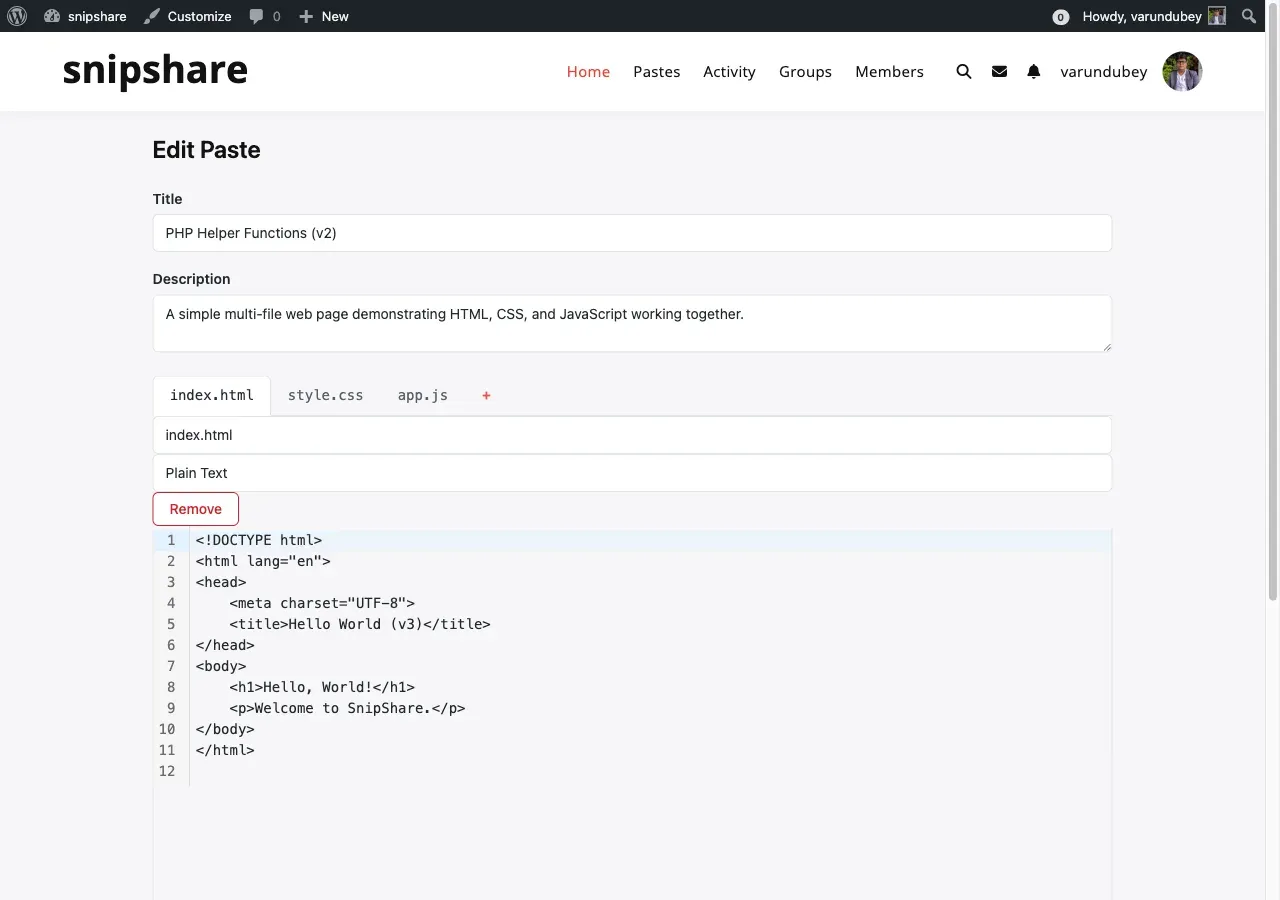
The edit form is identical to the create form. Changes you make:
- Update the paste title, description, visibility, expiration, or tags
- Edit file content or filename: every file you change generates a new revision (previous version is preserved in revision history)
- Add new files: new file tabs can be added up to the max files limit
- Remove files: file tabs can be deleted (at least one must remain)
After saving, the paste version number increments. Changed files get a new entry in the revisions table. Unchanged files are not affected.
An optional Change Note field (up to 500 characters) lets you describe what changed - this note appears in the revision history.
Viewing Revisions
Section titled “Viewing Revisions”Every time a paste is edited, per-file revision records are created. View the full history at:
/paste/{hash}/revisions/The revision history shows each version with timestamp, author, and change note.
To compare two versions:
/paste/{hash}/diff/1...2Replace 1 and 2 with the version numbers to compare. See Revision History for more.
Forking a Paste
Section titled “Forking a Paste”Forking clones a paste (all its files) into your own account. The fork is a new, independent paste - changes to the fork don’t affect the original.
To fork: Click the Fork button on any public paste page.
The forked paste:
- Has
parent_idset to the original paste’s ID - Increments the original paste’s
fork_count - Fires a BuddyPress notification to the original paste owner (if notifications enabled)
- Belongs to you - you can edit, delete, and manage it independently
Requires Paste Forking to be enabled in Settings → General, and the snipshare/fork-paste ability.
Downloading a Paste
Section titled “Downloading a Paste”Download buttons are available on the paste view page.
| Paste type | Download format |
|---|---|
| Single-file paste | Original file with its natural filename |
| Multi-file paste | ZIP archive named after the paste title |
Direct download URLs:
/paste/{hash}/download/Multi-file ZIP downloads require the PHP ZipArchive extension. See Requirements for details.
Raw View
Section titled “Raw View”View the raw, unformatted text content of a paste at:
/paste/{hash}/raw/For multi-file pastes, files are concatenated with // filename.ext separators.
To view a specific file only:
/paste/{hash}/raw/{filename}Raw URLs respect access control - password-protected and private pastes return 403 for unauthorized visitors.
Deleting a Paste
Section titled “Deleting a Paste”To delete: Click the Delete button on your paste. This moves the paste to the trash (status = trashed). Trashed pastes are no longer accessible at their URL.
Administrators can view and permanently delete trashed pastes from SnipShare → All Pastes in the admin.
Moderators (users with the snipshare/moderate ability) can trash any paste regardless of ownership.
Password-Protected Pastes
Section titled “Password-Protected Pastes”When visiting a password-protected paste, you see a password prompt. Enter the correct password to unlock the paste for your session.
- The unlock is session-scoped - navigating away and returning requires re-entry
- The shortcode
[snipshare hash="..."]shows a locked placeholder for unverified sessions - oEmbed does not expose password-protected paste content