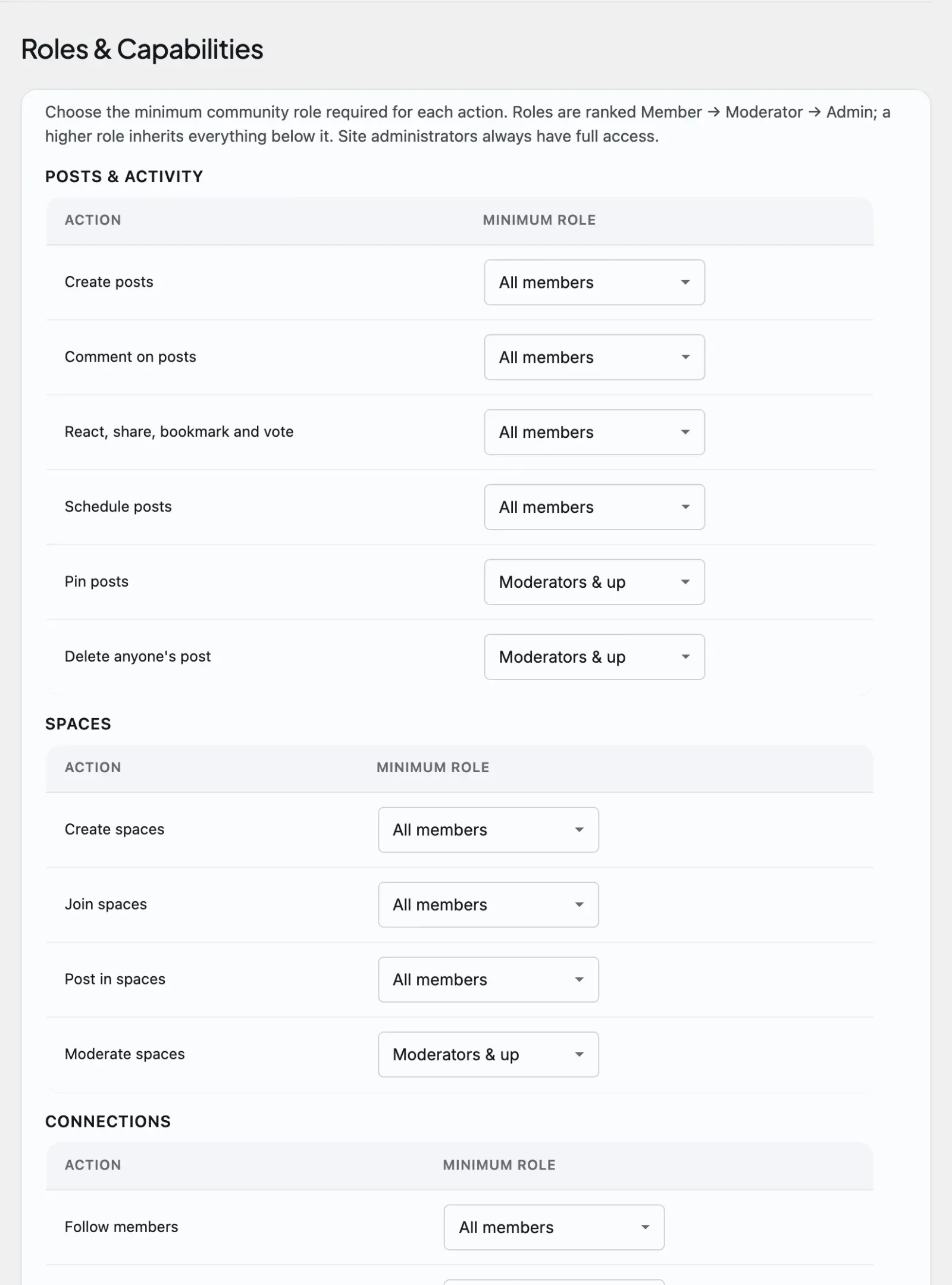
How BuddyNext decides who can do what. This page covers the permission model developers extend: the single buddynext_can() entry point, the four resolution layers in PermissionService, the capability catalog registered through the WordPress Abilities API, and the filter seams (buddynext_user_can, buddynext_role_map, buddynext_abilities) an extension uses to add, gate, or override a capability.
BuddyNext does not register any custom WordPress roles. Neither Free nor Pro makes an add_role() call, and Pro’s manifest confirms this with customRoles: []. There are no new WP_Role capabilities to map. Member authority is modeled in two BuddyNext-owned layers instead:
A community role stored in user meta (bn_community_role): one of member, moderator, admin. Defaults to member when unset. RoleService::set_role() ignores any other value; owner exists only as a per-space role (below).
A per-space role stored in the bn_space_members table (role column): owner, moderator, or member for an active membership.
WordPress site administrators are recognized through the native manage_options capability, not a BuddyNext role. Every wp-admin screen BuddyNext registers gates on manage_options (see Admin Pages and Settings).
Every permission decision in the plugin flows through one function:
Defined in buddynext.php, it resolves the permissions service from the container and calls PermissionService::can(). Never call current_user_can() against a BuddyNext capability or read bn_community_role directly to make an authorization decision - route it through buddynext_can() so all four layers and the filter seams apply.
PermissionService::can() resolves a check in this order:
Layer
Source
Effect
1. WP site admin
manage_options
Holders pass every check ($result = true). Logged-out visitors resolve to false before this layer.
2. Community / space role
ROLE_MAP + role hierarchy
The capability needs a minimum role; the user’s community role (or in-space role when space_id is in context) must meet or exceed it.
3. Explicit ability grant
bn_ability_{slug} user meta
A per-user grant with an expiry (0 = never, otherwise a unix timestamp). Checked only when the role check fails.
4. Developer filter
buddynext_user_can
Runs on every check and can flip the resolved result in either direction. Always the final word.
Three hard-deny short-circuits apply around the layers above:
A user who is space-banned (a row in bn_space_bans, or a bn_space_members row with status = 'banned') is denied every buddynext-spaces/* capability when a space_id is in context, regardless of role.
A suspended member is denied every capability except buddynext-profile/view and buddynext-moderation/review-queue (PermissionService::READ_CAPS), so write controls hide and writes refuse from one source. Site admins are exempt.
The space-scoped capabilities buddynext-moderate-space, buddynext-manage-space, and buddynext-own-space bypass the generic role map and resolve through dedicated methods that read the caller’s role in that specific space.
Roles are ranked numerically. A capability mapped to a role is granted to that role and everything above it. PermissionService ranks four roles; the community role only ever holds admin, moderator or member, and owner applies to the in-space role of a space owner.
Role
Weight
owner
4
admin
3
moderator
2
member
1
A capability mapped to null in the role map has no role gate - it can only be granted through an explicit ability grant or the buddynext_user_can filter.
Capabilities are dot-namespaced slugs (buddynext-{domain}/{action}).
There are three lists in code and they are not the same list. Know which one you are looking at:
List
Where
What it decides
PermissionService::ROLE_MAP
includes/Core/PermissionService.php
Enforcement. The default role each capability requires. This is the authority - if a slug is here, it is gated.
Abilities::CATALOG
includes/Core/Abilities.php
Registration with the WordPress Abilities API (WP 6.9+), so the capability appears in the admin Abilities UI and can be granted or revoked through that API. On WordPress below 6.9 this no-ops silently and PermissionService still enforces the gate.
RolesTab::catalog()
includes/Admin/RolesTab.php
The admin Roles tab. A deliberate subset - the capabilities a site owner is offered a UI control for. handle_save() drops any submitted slug that is not in it.
Enforcement is the list that matters for buddynext_can(). The other two only decide whether an owner gets a control for it.
The role map holds 24 generic capabilities:
Capability
Default required role
buddynext-profile/edit-own
member
buddynext-profile/edit-any
admin
buddynext-profile/view
none (public)
buddynext-feed/create-post
member
buddynext-feed/delete-own-post
member
buddynext-feed/delete-any-post
moderator
buddynext-feed/schedule-post
member
buddynext-feed/interact
member (umbrella for react, share, bookmark and poll vote; on the Roles tab as “React, share, bookmark and vote” and enforced on those REST routes; not in Abilities::CATALOG)
buddynext-comments/create
member
buddynext-spaces/create
member (see note)
buddynext-spaces/join
member
buddynext-spaces/join-gated
none
buddynext-spaces/post
member
buddynext-spaces/moderate
moderator
buddynext-spaces/manage-settings
moderator
buddynext-spaces/delete
moderator
buddynext-connections/follow
member
buddynext-connections/connect
member
buddynext-moderation/report
member
buddynext-moderation/review-queue
moderator
buddynext-moderation/dismiss
moderator (acting on a report; on the Roles tab as “Resolve reports”; not in Abilities::CATALOG)
buddynext-moderation/issue-strike
moderator
buddynext-moderation/suspend-user
moderator
A site-wide moderator holds full moderation authority. Clearing the queue, issuing strikes, suspending, shadow-banning, and warnings are all moderator powers. Only appeals, and editing what each role is allowed to do, remain admin-only.
buddynext-spaces/create has one option that overrides its default. The legacy Spaces-tab “who can create spaces” setting is folded into the role map: when get_option( 'buddynext_space_creation_role' ) is 'admin', the map default flips from member to admin. The default ('member') leaves the map untouched. It is applied inside role_map() so it composes with the Roles and Capabilities tab instead of fighting it.
buddynext-comments/create is grantable from the admin. It is present in PermissionService::ROLE_MAP, in Abilities::CATALOG, and in RolesTab::catalog(), so it is registered with the WordPress Abilities API and renders a row (“Comment on posts”) on the Roles and Capabilities tab like any other capability. The filter also works if you want to set the role in code:
Three additional space-scoped capabilities - buddynext-moderate-space, buddynext-manage-space, and buddynext-own-space - are resolved by dedicated per-space methods (can_moderate_space() / can_manage_space() / can_own_space()) and are not part of the generic role map. buddynext-moderate-space and buddynext-manage-space are both granted to a space owner OR moderator (moderators can manage space settings, they just cannot remove the owner or delete the space); buddynext-own-space is the strictly owner-only gate, split out for the two things a moderator must never do because neither is reversible from their side: delete the space, and change who owns it (transfer ownership, assign a new owner).
Ability slugs may contain / and -. The grant meta key translates those to _, so buddynext-feed/schedule-post is stored as bn_ability_buddynext_feed_schedule_post. Use PermissionService::ability_meta_key( $slug ) to build the key rather than hand-rolling it.
Adding a capability is two filters: register the slug with the Abilities API, then give it a role in the role map. Do both on plugins_loaded (or earlier) so they are in place before any check runs.
// 1. Add the slug to the catalog so the Abilities API registers it.
No custom roles to clean up. Because BuddyNext registers no WP_Role, there is nothing to remove on deactivation and no capability bloat on the administrator role. Authority lives in user meta and bn_space_members.
manage_options is the admin gate, not a BuddyNext role. Site admins pass every buddynext_can() check by virtue of layer 1, and every BuddyNext admin screen checks manage_options directly.
buddynext_role_map fires once and is memoised per request; buddynext_user_can fires on every check. Put baseline role mappings in the role map and per-decision logic in the filter.
Space context matters. For buddynext-spaces/* capabilities, pass ['space_id' => N] so the in-space role (from bn_space_members) is used. The join capability is the exception - a non-member has no in-space role yet, so join is gated by the community role, with space type (open/request/invite) enforced separately in the join flow.
Free / Pro boundary. The catalog and the four-layer model live entirely in free. Pro consumes buddynext_can() like any other caller and does not add custom roles or its own permission engine.
See also Admin Pages and Settings for how the admin surface gates on manage_options, and the REST contract page for how controllers resolve buddynext_can() before serving a request.