

Hooks: Notifications and Email
BuddyNext overviewFree + ProGet BuddyNext →
The action and filter seams for the notification lifecycle and the email system. This page is for developers adding a notification channel (push, SMS), suppressing or deferring notifications, capturing outbound email, or registering a new notification type that emails its recipient. Everything here is fired by BuddyNext Free; Pro push is the reference consumer.
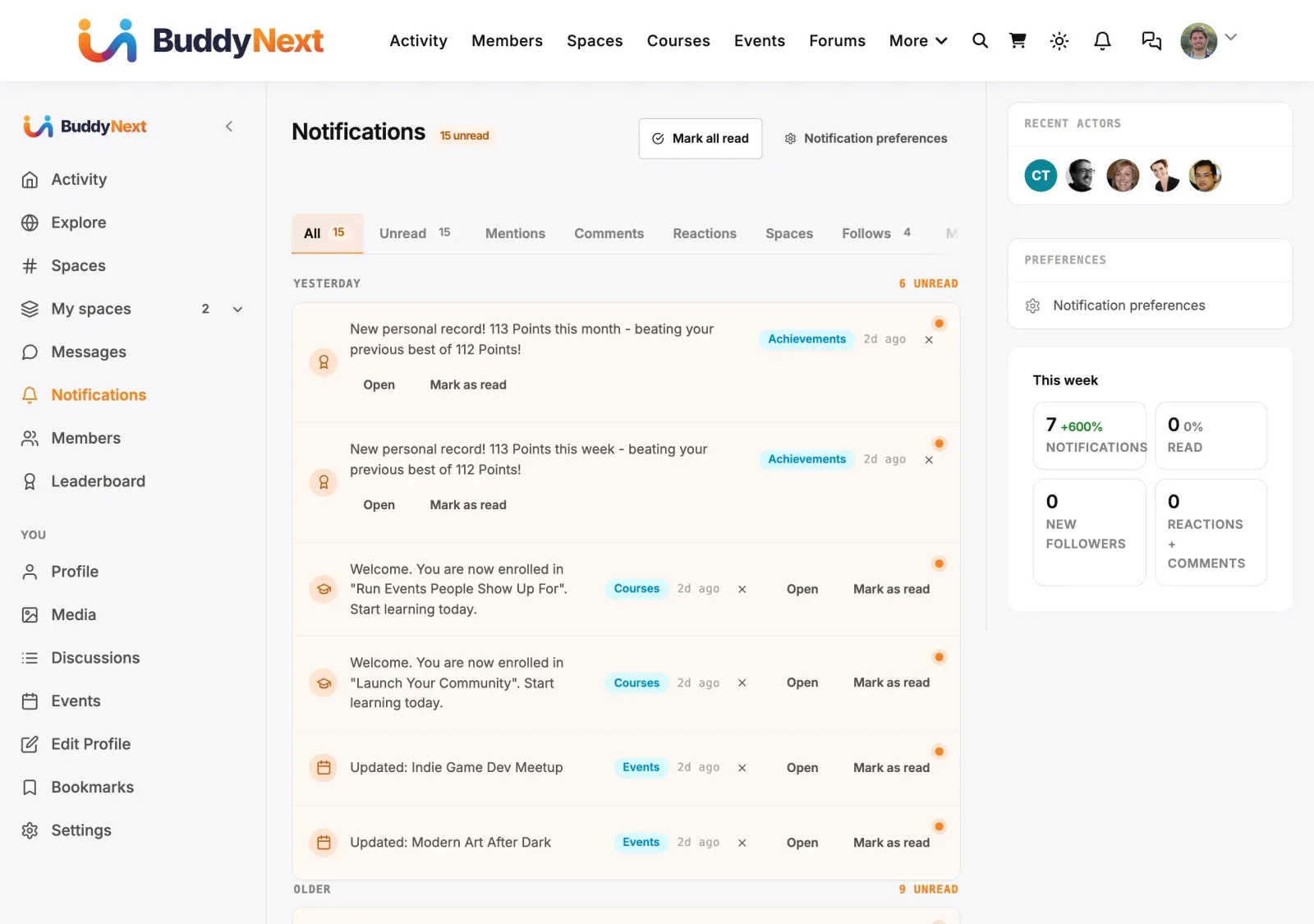
Overview / Contract
Section titled “Overview / Contract”Every notification fans in through one method: NotificationService::create( array $data ). That method enforces a single, ordered pipeline so each notification passes the same gates regardless of which feature raised it.
NotificationService::create( $data ) 1. in-app preference check -> buddynext_notification_force_on_site (filter, escape hatch) 2. should-send gate -> buddynext_notification_should_send (filter, return false to drop) 3. deferral resolution -> buddynext_notification_send_at (filter, schedule for later) 4. write row (insert OR merge into an unread group row) 5. fire -> buddynext_notification_created (action) |- EmailDispatchListener -> EmailSender::send() -> email channel |- Pro PushDispatcher -> push channel (priority 20)Key contract rules:
- One creation path, one created action. Both the fresh-insert path and the group-merge path resolve the gate and deferral filters and then fire
buddynext_notification_createdwith the same payload shape. A listener does not need to know whether a row was inserted or merged. $datais the payload everywhere. The$dataarray passed tocreate()is the same array handed tobuddynext_notification_should_send,buddynext_notification_send_at, and the third argument ofbuddynext_notification_created. It carries at leastrecipient_idandtype, plus optionalsender_id,object_type,object_id,group_key, and a nesteddataarray.- Returning 0 means nothing was sent. If a preference suppresses the notification, the should-send gate returns false, or the write fails,
create()returns0and never fires the created action. Channels (email, push) only run when a row actually exists. - Channels are listeners, not core branches. The email channel is
EmailDispatchListenerhooked onbuddynext_notification_createdat priority 10. Pro’s push channel is a separate listener on the same action at priority 20. Adding a channel means adding a listener, not editing core.
Notification lifecycle hooks
Section titled “Notification lifecycle hooks”| Hook | Type | Fired when | Parameters |
|---|---|---|---|
buddynext_notification_should_send |
filter | Before any write, deciding whether to persist the notification | bool $should, array $payload |
buddynext_notification_send_at |
filter | After the should-send gate passes, resolving deferred delivery | ?string $send_at, array $payload |
buddynext_notification_force_on_site |
filter | When checking the recipient’s in-app preference, to force-send a critical type | bool $force, int $recipient_id, string $type, array $data |
buddynext_transactional_notification_types |
filter | Resolving which notification types are transactional, meaning they bypass the member’s email preferences entirely and always send. The core set is email_verify and welcome. Add a type here only when the member genuinely cannot opt out of it - the case this was opened for is Pro’s upcoming-renewal notice, where EU and California auto-renewal rules require advance notice before a card is charged. The returned array is cast to strings, de-duplicated and emptied of blanks. |
string[] $types |
buddynext_notification_created |
action | After a notification row is inserted or merged into an unread group | int $notification_id, int $recipient_id, array $data |
buddynext_notification_ungroupable_types |
filter | Resolving which notification types must never collapse into a grouped row | string[] $types |
buddynext_media_notification_url |
filter | Resolving where a media notification (comment, favorite, reaction, mention) opens | string $url, int $media_id |
buddynext_notification_visible_rows |
filter | Reading a page of a member’s notifications, after rows whose object is gone are dropped | array[] $rows |
buddynext_notification_sources |
filter | Listing the integrations whose notification hook carries the shared payload | array $sources |
buddynext_integration_notification_payload |
filter | A partner plugin’s notification arrives through the contract, before it is stored. A bridge can adjust it, for example set one group_key per course with renotify => false so a repeat refreshes the same bell row. Since 1.2.5. |
array $payload, string $source |
buddynext_notification_group_label |
filter | Naming a settings section BuddyNext does not own (an integration’s) | string $label, string $group |
Details:
-
buddynext_notification_should_senddefaults totrue. Returnfalseto drop the notification silently before it reaches the database or any channel. Pro AI fatigue detection uses this to suppress low-signal notifications. -
buddynext_notification_send_atdefaults tonull(send now). Return a MySQL / ISO 8601 datetime string to mark the notification for deferred delivery. Free stores the value in the row’sdataJSON; Pro acts on it for quiet-hours and digest batching. -
buddynext_notification_force_on_sitedefaults tofalse. Unknown or system types already default to on-site = true, so critical notices are never suppressed by an absent preference; this filter is the escape hatch for forcing a normally-opt-out type through. -
buddynext_notification_ungroupable_typesdefaults to an empty array. A type belongs on this list when each occurrence is individually actionable or individually meaningful - a direct message is not “3 messages”, it is three things you have to read. Grouping is per PAGE: repeats that span a page boundary stay separate, because aggregating in SQL would break the keyset cursor the list pages on. The visible item count therefore varies per page, while the cursor still advances by ROWS, so nothing is skipped.add_filter( 'buddynext_notification_ungroupable_types', function ( array $types ): array {$types[] = 'my_plugin_approval_request'; // each one needs its own decisionreturn $types;} ); -
buddynext_media_notification_urldefaults to'', which falls back to the activity feed. The WPMediaVerse bridge answers with the post the media is in, or the media’s own page. -
WB Gamification decides which personal records reach the inbox with its own
wb_gam_personal_record_notifyfilter (default:weekandmonthrecords whose previous best was at least 10). A record is announced once per period (one row per member per site-calendar week or month); later records in the same period refresh that row’s number without a new alert. -
buddynext_notification_visible_rowsreceives the raw rows of one page (each hasrecipient_id,type,object_type,object_id,sender_idand the JSONdata). It is for a plugin whose notifications are mirrored into the bell: that plugin owns who may see its content, so it removes its own rows the recipient should not see (a banned author, trashed content). Return every other row untouched. It filters the list only; unread counts are not recalculated.add_filter( 'buddynext_notification_visible_rows', function ( array $rows ): array {return array_filter( $rows, function ( array $row ): bool {return 'my_plugin.notice' !== $row['type'] || my_plugin_can_see( (int) $row['recipient_id'], (int) $row['object_id'] );} );} ); -
buddynext_notification_createdis the canonical “a notification happened” signal. The$typelives at$data['type']. Note the parameter order:$notification_id, $recipient_id, $data(the data array, not a bare type string). -
buddynext_notification_sourceslists the integrations that send notifications to the bell through one shared payload. Each plugin passes that payload as the LAST argument of its own notification hook, so its other listeners are untouched; BuddyNext reads it, shows it in the bell with the plugin’s words, link and icon, and never emails it (the plugin sends its own email). Our plugins are registered already. Add yours to take part:add_filter( 'buddynext_notification_sources', function ( array $sources ): array {$sources['my_plugin'] = array('hook' => 'my_plugin_notification_created', // your existing hook'prefix' => 'my_plugin', // for my_plugin_community_notification_types / _visible / _removed'label' => __( 'My plugin', 'my-plugin' ),'icon' => 'bell',);return $sources;} );// Wherever you notify a member: your existing arguments, then the payload.do_action( 'my_plugin_notification_created', $notification_id, array('recipient_id' => $user_id,'type' => 'item_approved','actor_id' => 0,'object_type' => 'item','object_id' => $item_id,'message' => __( 'Your item was approved.', 'my-plugin' ), // plain text'url' => get_permalink( $item_id ),'group_key' => '', // same key = unread rows merge ("Aisha and 3 others...")) );Declare your types on
{prefix}_community_notification_types(slug =>label,description,default_on) to give members a switch per type; answer{prefix}_community_notification_visible(array $visible, int $viewer_id, array $targets, return key => bool) to hide rows the viewer may no longer see; fire{prefix}_community_notification_removed( $object_type, $object_id )when an object is permanently deleted. Fire{prefix}_community_notification_read( $object_type, $object_id, $user_id )when one member has read the object in your plugin (opened the conversation): that member’s rows for it are marked read and their unread count drops, while other recipients keep theirs. A grouped row (“Aisha and 2 others replied”) carries the container as its object (the topic) and one event per person: senditem_typeanditem_id(the reply),message_single(one person,{actor}placeholder) andmessage_grouped({actor}and{others}, which becomes a translated “1 other” / “3 others”). BuddyNext keeps each event as (person, item), counts people, not events, and asks your_visiblefilter about each item too (targetitem => true, with the person asactor_id): answer false for a gone, trashed or banned item and the row shrinks, then disappears when none is left. Send an anonymous event withactor_id0 and its owngroup_keyand it never merges. Thegroup_keyand the object must describe whaturlopens, because a merged row keeps the first event’s link. BuddyNext reads the payload only once your types are declared. For a running notice whose number only grows (a weekly best), add'renotify' => falsewith agroup_keyper period: repeats then refresh the existing row quietly instead of alerting again.Email. Contract types are bell-only by default. While BuddyNext is active it owns member email, so a plugin that stops sending its own should let BuddyNext send it instead: add
'email' => trueto the type’s declaration. That type then appears in the member’s notification settings with email on (they can turn it off), and BuddyNext emails yourmessageas the subject with a View link to yoururl, in the site’s email layout. A site or another plugin can opt a type in or out without your release throughbuddynext_notification_type_email(bool $emails, string $source, string $slug, array $type). Example: BuddyNext’s own MediaVerse bridge optsmediaverse.media_mentionin, while reactions stay bell-only. -
buddynext_notification_group_labelnames a settings section by its group key when BuddyNext does not own the group. Integration sections are named already.
Preference hooks
Section titled “Preference hooks”| Hook | Type | Fired when | Parameters |
|---|---|---|---|
buddynext_notification_prefs |
filter | Resolving a user’s full preference map | array[] $prefs, int $user_id |
buddynext_notification_prefs_catalogue |
filter | Building the list of notification types shown on the preferences screen | array $catalogue |
buddynext_notification_prefs_before |
action | Rendering the top of the notification preferences template | int $user_id |
buddynext_notification_prefs_after |
action | Rendering the bottom of the notification preferences template | int $user_id |
buddynext_notification_prefs is how a channel plugin injects its own preference rows without modifying Free. The map is keyed by notification type; each entry follows Free’s shape (at minimum { on_site: bool, email_freq: string }) plus any channel keys your plugin owns. Pro push attaches here:
// Pro PushPrefService registers on Free's filter.add_filter( 'buddynext_notification_prefs', function ( array $prefs, int $user_id ): array { foreach ( $prefs as $type => &$row ) { $row['push_enabled'] = my_push_pref( $user_id, $type ); // bool } return $prefs;}, 10, 2 );Email hooks
Section titled “Email hooks”The email channel is driven by EmailSender. Event emails render from a bn_email_templates row keyed by notification type; a composed email (a campaign or drip step that carries its own subject and body) bypasses the template row. Both paths converge on one wp_mail() call wrapped by the same identity and shell.
| Hook | Type | Fired when | Parameters |
|---|---|---|---|
buddynext_email_payload |
filter | Immediately before wp_mail(), after subject/body/headers are assembled |
array $payload, string $template_slug, array $context |
buddynext_email_shell |
filter | Wrapping the email body in the branded HTML shell; return HTML containing the literal {{email_body}} token to fully replace the default shell |
string $shell, string $body, string $subject |
buddynext_queue_email_digest |
action | A notification is routed to a digest queue instead of an immediate send | int $user_id, string $notification_type, array $data |
buddynext_send_notification_email |
action | Action Scheduler callback to send a notification email asynchronously | int $user_id, string $notification_type, array $data |
buddynext_email_template_catalogue |
filter | Building the list of templates on Settings -> Notifications -> Email Templates | array $catalogue |
buddynext_email_test_placeholders |
filter | An owner sends a test of an email template. Supply sample values for the tokens your own templates use, or the test shows them as raw {{braces}}. Since 1.2.4. |
array $placeholders, string $slug |
buddynext_logs_purged |
action | A retention purge finishes, so a site can log or monitor what was removed | array{notifications:int,email_log:int} $deleted, int $window |
buddynext_email_failure_alert_threshold |
filter | The Email Log admin banner decides whether to warn about delivery. It shows once failed sends in the last 24 hours reach this number. Default 5; return 0 to never show it (1.2.0) |
int $threshold |
Details:
-
buddynext_email_payloadreceives$payloadwith keysto,subject,body,headers. Return the array to modify recipients, subject, or body. Return an array with'send' => falseto suppress thewp_mail()call entirely - Pro broadcast and drip use this to capture the message for batched campaign delivery rather than sending inline.$template_slugis the notification type (matchesbn_email_templates.type);$contextis the original$dataarray. -
Sender identity is centralized:
EmailSender::from_name()andfrom_address()fall back to the site name and admin email when Settings -> Email is blank, andbuild_identity_headers()applies the configured Reply-To as a per-message header so it survives anywp_mail_fromoverride. -
buddynext_email_template_catalogueis how a plugin puts its own emails on the owner’s editor screen, and it is not cosmetic. That screen writes tobn_email_templates, which is whereEmailSenderreads the subject, the body, and theenabledflag it checks before sending. A type absent from the catalogue cannot be switched off by the owner at all - on a screen that lists every other email the site sends, which reads as “that email does not exist here”. Seeding a row is half the feature; this filter is the other half.Add a group keyed by its heading. Every key is required, and
tokensdrives the test-send sampler - a token you leave out of it reaches the owner’s test email as a literal{{brace}}.add_filter( 'buddynext_email_template_catalogue', function ( array $catalogue ): array {$catalogue[ __( 'Mentoring', 'my-plugin' ) ] = ['my.mentor_assigned' => ['name' => __( 'Mentor assigned', 'my-plugin' ),'trigger' => __( 'When a mentor is assigned to a member', 'my-plugin' ),'tokens' => [ '{{user_name}}', '{{site_name}}', '{{action_url}}', '{{unsubscribe_url}}', '{{mentor_name}}' ],'subject' => 'Meet your mentor, {{mentor_name}}','preview' => 'Your mentor is ready to say hello','body' => '<p>Hi {{user_name}},</p><p>{{mentor_name}} is now your mentor on {{site_name}}.</p><p><a href="/products/buddynext/developer-guide/{{action_url}}/">Say hello</a></p>',],];return $catalogue;} );Define this copy once and have your installer’s seed read the same array. Two literals - one seeded, one for the editor - drift apart silently, and the drift lands in the worst possible place: the owner edits one body and the member receives the other.
-
The digest path fires
buddynext_queue_email_digestwhen an event is destined for a digest rather than an immediate email. There is no per-user accumulator meta: the daily and weekly digest crons batch straight from thebn_notificationsrows (joined againstbn_notification_prefs), so nothing has to be written to a queue and kept in sync. A member’s per-typeemail_freqpreference (immediate,daily,weekly,off) decides whether an event emails immediately, is picked up by the digest cron, or is suppressed.
More notification and email seams
Section titled “More notification and email seams”Narrower hooks around message copy, delivery tuning, and the notification templates. Same table shape as above.
| Hook | Type | Fired when | Parameters |
|---|---|---|---|
buddynext_notification_message |
filter | A notification’s text is composed for a type Free does not know. Bridge plugins return copy for their own types; a non-empty string suppresses the fallback warning. | string $message, string $type, string $actor_name, int $object_id, array $data |
buddynext_notification_meta |
filter | The notification center resolves the icon, tone, and label for a type Free does not know (integration types such as suite.*). |
array $meta, string $type ($meta has icon, tone, label) |
buddynext_notification_fanout_batch |
filter | A space post fans out to members in batches. Sets how many members each batch handles. | int $size |
buddynext_push_available |
filter | BuddyNext asks whether push can really deliver. Free only asks while the Pro push feature is on; Pro answers with its configured state. | bool $available (default true) |
buddynext_email_header_html |
filter | The email header block (inside the coloured header cell) is built. | string $header_html, string $subject |
buddynext_email_footer_html |
filter | The email footer block is built. | string $footer_html, string $subject |
buddynext_email_default_history |
filter | The email template registry loads, so a plugin can register templates whose default wording changed. | array $history (template type => current, previous list) |
buddynext_notification_prefs_channels_after |
action | Inside the Channels card of the notification preferences page, after the core channel toggles and inside the buddynext/notification-prefs Interactivity scope. |
int $current_user_id |
buddynext_notifications_before / buddynext_notifications_after |
action | Before and after the notifications page content. | int $current_user_id |
Examples
Section titled “Examples”Register a new notification type with its own listener
Section titled “Register a new notification type with its own listener”Raise a notification through the canonical service so it inherits the full pipeline (preferences, gating, grouping, email + push channels). You do not register a listener to receive the created action for your own type; you call create() and the existing channel listeners deliver it. Add an email template row for the type if you want it to email.
// 1. Raise the notification from wherever your event commits.add_action( 'my_plugin_mentor_assigned', function ( int $mentee_id, int $mentor_id ): void {    buddynext_service( 'notifications' )->create( [        'recipient_id' => $mentee_id,        'sender_id'    => $mentor_id,        'type'         => 'mentor_assigned',      // your custom type slug        'object_type'  => 'user',        'object_id'    => $mentor_id,        'group_key'    => 'mentor_assigned_' . $mentee_id, // optional: merge bursts        'data'         => [ 'mentor_id' => $mentor_id ],    ] );}, 10, 2 );
// 2. (Optional) Provide the human-readable message string for in-app + email + push.//    The filter passes five arguments and expects a string back.add_filter( 'buddynext_notification_message', function ( string $message, string $type, string $actor_name, int $object_id, array $data ): string {    if ( 'mentor_assigned' === $type ) {        return sprintf( __( '%s was assigned as your mentor.', 'my-plugin' ), $actor_name );    }    return $message;}, 10, 5 );
// 3. (Optional) Provide the click-through URL for the notification. Same five-arg//    shape; return an absolute URL (or the passed-in $url to leave it unchanged).add_filter( 'buddynext_notification_url', function ( string $url, string $type, int $actor_id, int $object_id, array $data ): string {    if ( 'mentor_assigned' === $type ) {        return home_url( '/mentorship/' . $object_id . '/' );    }    return $url;}, 10, 5 );
Because the notification flows through create(), the in-app row, the email (if a template or message exists), and Pro push all dispatch from the single buddynext_notification_created action - no per-channel wiring on your side.
Suppress a notification with buddynext_notification_should_send
Section titled “Suppress a notification with buddynext_notification_should_send”Drop a notification before it is written or emailed. This runs in both the insert and group-merge paths, so a suppressed type never leaks through grouping.
add_filter( 'buddynext_notification_should_send', function ( bool $should, array $payload ): bool { // Stop low-signal 'reaction' notifications during a recipient's quiet window. if ( 'reaction' === ( $payload['type'] ?? '' ) && my_is_in_quiet_hours( (int) $payload['recipient_id'] ) ) { return false; // create() returns 0; no row, no email, no push. } return $should;}, 10, 2 );To defer rather than drop, return a future datetime from buddynext_notification_send_at instead:
add_filter( 'buddynext_notification_send_at', function ( ?string $send_at, array $payload ): ?string { if ( my_is_in_quiet_hours( (int) $payload['recipient_id'] ) ) { return gmdate( 'Y-m-d H:i:s', strtotime( 'tomorrow 8:00' ) ); } return $send_at;}, 10, 2 );Notes / gotchas
Section titled “Notes / gotchas”buddynext_notification_createdcarries the data array, not a type string. The third argument is the full$datapayload; read the type from$data['type']. Some older integration snippets pass a bare$typeas the third arg - the current signature is( int $notification_id, int $recipient_id, array $data ).- Channels run at distinct priorities. Email dispatch is priority 10, Pro push is priority 20, both on
buddynext_notification_created. Pick a priority that does not collide if you add another channel. - Suppression vs deferral are different filters.
buddynext_notification_should_senddrops permanently;buddynext_notification_send_atschedules. Do not use a should-send return of false expecting a retry. - Composed emails bypass template rows. A disabled
bn_email_templatesrow suppresses its own event email but never a composed campaign or drip email, which carries its own subject and body throughbuddynext_email_payload. Suppressing campaign mail is the'send' => falsereturn, not a template toggle. - Free vs Pro. Free fires every hook on this page and ships the email channel. Pro push (
PushDispatcheronbuddynext_notification_created,PushPrefServiceonbuddynext_notification_prefs) is the reference example of adding a channel without touching Free. For the social and engagement actions that typically raise notifications, see Hooks: Members, Profiles, and Social Graph.