

Hooks: Members, Profiles, and Social Graph
BuddyNext overviewFree + ProGet BuddyNext →
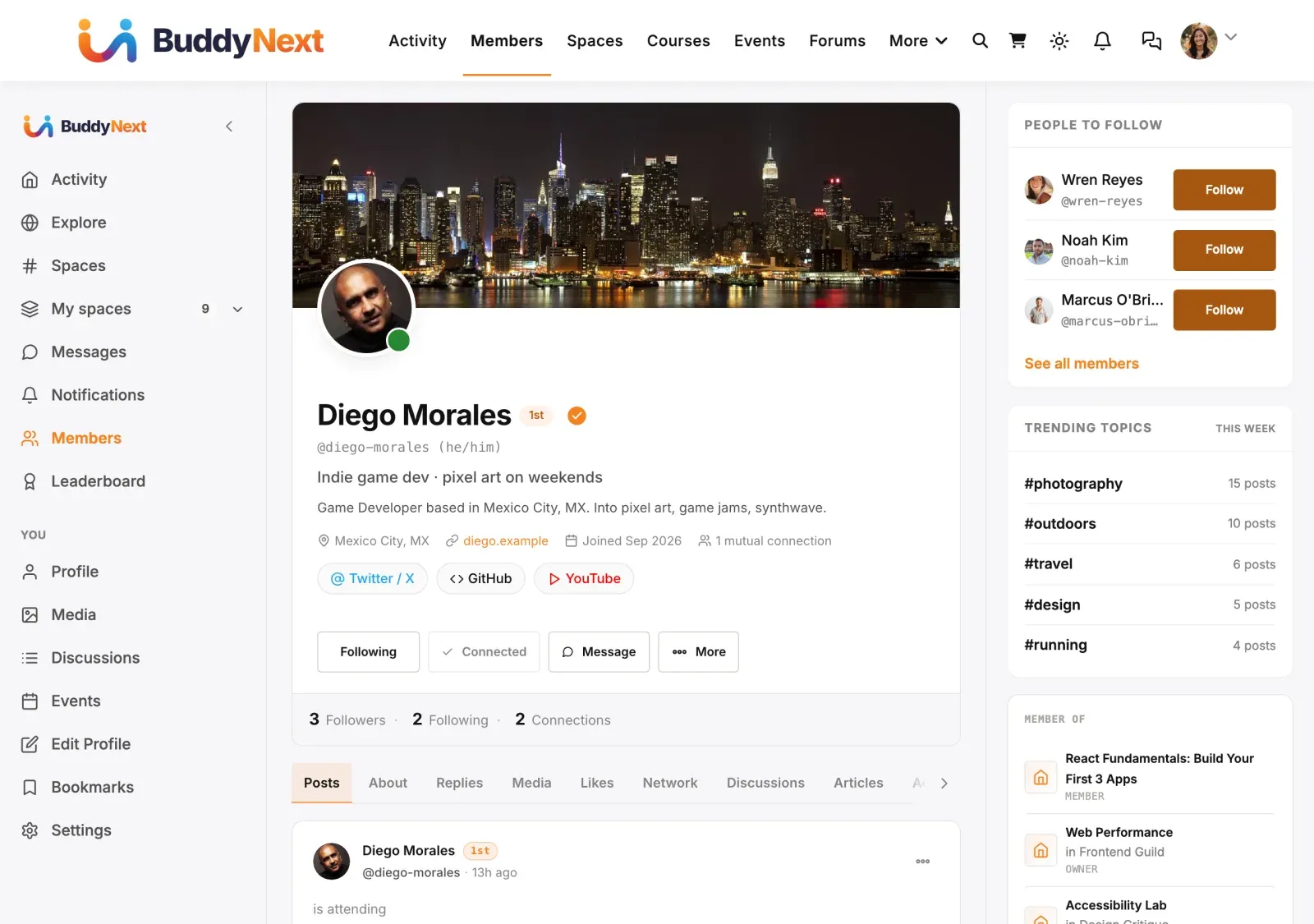
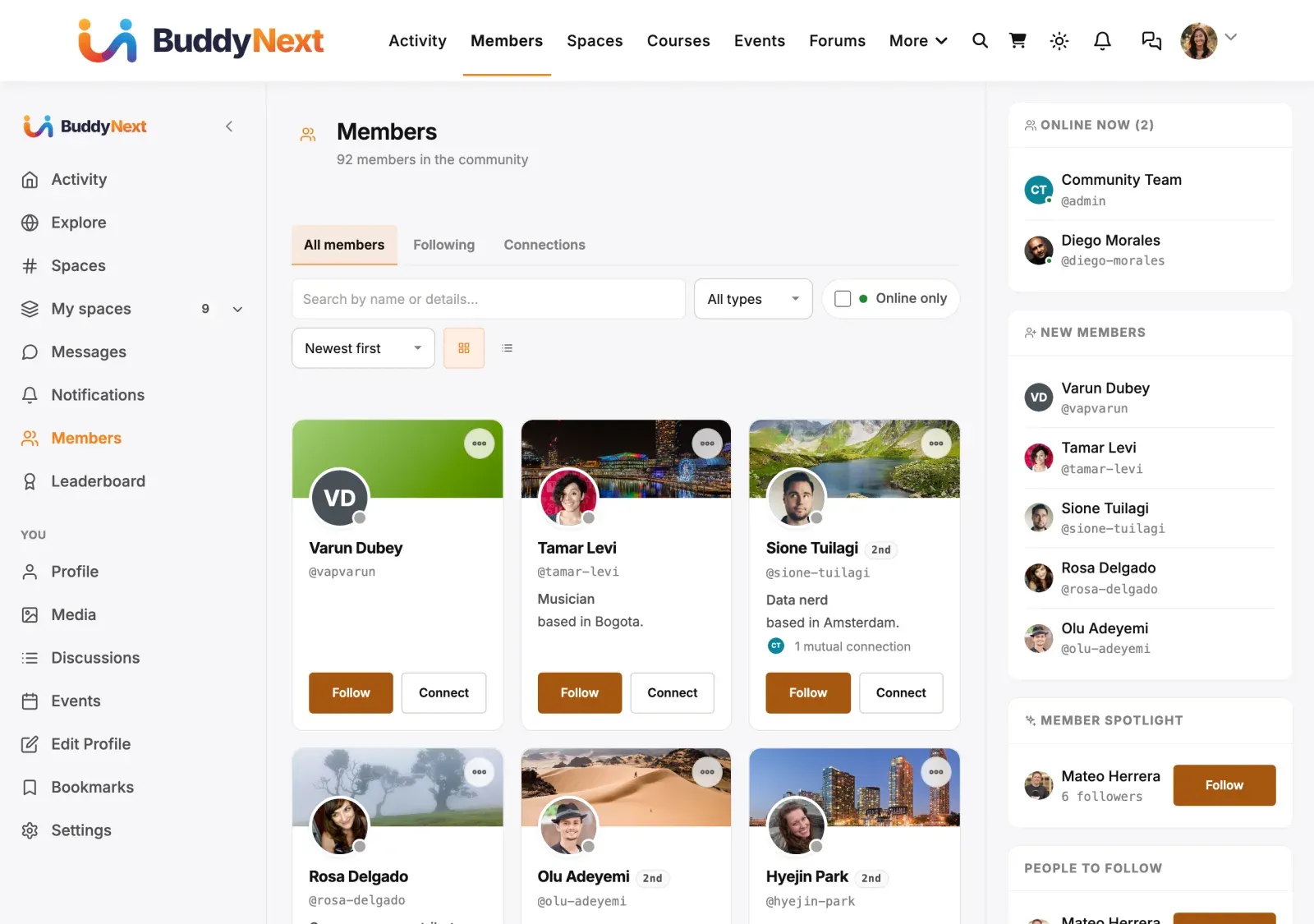
The action and filter seams for user lifecycle, member profiles, profile fields, roles, and the social graph (follow, connection, block). This page is for developers building gamification plugins, integrations, or theme extensions that react to social activity or augment how members are rendered. Every hook below is fired or applied by BuddyNext Free, so it is available without Pro.
Overview / Contract
Section titled “Overview / Contract”- Actions are notifications, not callbacks. BuddyNext never calls addon code directly. It fires actions after a state change has committed, and you hook them. Listeners that need more than the passed IDs should re-fetch by ID (for example
buddynext_service( 'post_service' )->get( $post_id )). - Filters either transform data or decide a yes/no. A validation filter returns the data to keep, or a
WP_Errorto reject. A gate filter returns a boolean. A render filter returns a string of HTML. - Actor vs recipient. BuddyNext fires an actor-perspective event for every social action (who did the thing) and, where it makes sense, a recipient-mirrored event alongside it (who the thing was done to). Gamification systems usually award the recipient. See Engagement events below.
- User-overlay render filters echo their return value raw at the call site. The hooked plugin is responsible for returning escaped HTML. The default value is an empty string, so BuddyNext renders nothing when no plugin hooks.
User and member lifecycle actions
Section titled “User and member lifecycle actions”| Hook | Type | Fired when | Parameters |
|---|---|---|---|
buddynext_handle_history_limit |
filter | A member changes their handle and BuddyNext records the old one. Caps how many previous handles are kept per member, so an old handle can still resolve to its owner instead of 404ing or being silently re-issued. Default 0 (keep them all). |
int $limit |
buddynext_profile_write_allowlist |
filter | The profile REST controller decides which fields a member may write about themselves. Anything not on the list is dropped rather than saved, so adding a custom field to the profile form also means adding it here. | string[] $keys (the accepted top-level keys) |
buddynext_reserved_profile_slugs |
filter | A member handle is generated or validated. These slugs are refused because they collide with BuddyNext’s own profile sub-routes (files, media, likes, …); a member claiming one would shadow their own tab. Add your own to reserve them. |
string[] $slugs |
buddynext_registration_pending |
action | A new registration is created but awaits admin approval | int $user_id, string $email |
buddynext_user_verified |
action | A member completes email verification | int $user_id |
buddynext_onboarding_completed |
action | A member finishes the onboarding wizard | int $user_id |
buddynext_member_suspended |
action | A member is suspended (member-domain mirror) | int $user_id, int $by_user_id |
buddynext_member_unsuspended |
action | A suspension is lifted | int $user_id, int $by_user_id from every call site, including the wp-admin Members screen. |
buddynext_member_approved |
action | A pending registration is approved | int $user_id |
buddynext_member_rejected |
action | A pending registration is rejected | int $user_id |
buddynext_purge_user_data |
action | A member is deleted and their relations are purged | int $user_id, string $context |
buddynext_purge_user_data is the canonical member-cleanup seam. It fires from MemberCleanupService::purge_user_relations() after BuddyNext removes the member’s own social-graph rows, counters, and profile values, and hard-deletes their authored posts and comments (GDPR erasure). Hook it - rather than deleted_user - to clean up any per-user rows your addon stores. $context ('delete' or the erasure context) is informational only; both contexts hard-delete.
Profile view seam
Section titled “Profile view seam”| Hook | Type | Fired when | Parameters |
|---|---|---|---|
buddynext_profile_viewed |
action | A member’s profile is served to a different viewer (never on self-view) | int $profile_user_id, int $viewer_id |
Note: The old
buddynext_profile_extra_datafilter that injected extra stat blocks into the profile header has been removed. Profile and space tabs are now registered through the unified Nav API - hookbuddynext_register_navto add a profile tab. See the integration registry (buddynext_integrations) for owner-toggle wiring.
Profile tab pagination
Section titled “Profile tab pagination”A page past the end of a list answers 404 with BuddyNext’s own “This page doesn’t exist any more” view.
On a profile only the Articles tab pages; BuddyNext’s other tabs are single pages, so /page/N/ on them
is a 404. A tab your plugin adds is left alone unless it answers this filter.
| Hook | Type | Fires when | Args |
|---|---|---|---|
buddynext_profile_tab_past_last_page |
filter | /members/{slug}/{tab}/page/N/ is requested for a tab BuddyNext does not own |
bool|null $past, string $tab, int $user_id, int $page - return true for 404, false to render, null (default) to leave it to the tab |
Profile field type and rendering filters
Section titled “Profile field type and rendering filters”These extend the profile field system. The default field types and labels are resolved through manager methods, never from a raw constant, so a filter is the supported way to add a type.
| Hook | Type | Fired when | Parameters |
|---|---|---|---|
buddynext_profile_field_types |
filter | Resolving the allowed field type slugs | string[] $types |
buddynext_profile_field_type_labels |
filter | Building the admin type dropdown | array<string,string> $labels |
buddynext_profile_field_render |
filter | Rendering a single field value (front-end / block) | string $html, string $type, array $field, mixed $value, int $user_id |
buddynext_profile_field_validate |
filter | Validating a field value before persistence | true|WP_Error $result, string $type, mixed $value, array $field, int $user_id |
buddynext_profile_field_type_options |
action | Rendering per-type config in the admin field builder | string $type, array $field |
buddynext_profile_field_updated |
action | A profile field definition is saved in the admin builder | int $field_id |
buddynext_profile_field_settings |
action | Rendering a field’s Add or Edit panel, for EVERY type (unlike buddynext_profile_field_type_options, which is per type) |
array $field, array $group - $field is empty on the Add panel |
buddynext_profile_field_options_sanitize |
filter | Sanitising the per-field add-on options posted as bn_field_options[*]. The built-in pass keeps scalars only; decode and sanitise structured values (e.g. JSON) for your own keys here |
array $out, array $raw |
buddynext_profile_field_row_badges |
action | After a field’s name in the admin field list | array $field, array $group |
buddynext_profile_field_setup_issues |
filter | Building the “Some profile fields need attention” notice on the Profile Fields screen. Append array( 'field_id' => int, 'message' => string ); the message follows the field label |
array $issues, array $groups |
buddynext_profile_field_wrapper_attributes |
filter | Printing the wrapper of one profile field on any member form: profile edit, signup, complete-profile and the admin member editor. Free always adds data-bn-field-key |
string $extra, array $field, int $user_id - return escaped attributes with a leading space; $user_id is 0 on signup |
buddynext_profile_group_wrapper_attributes |
filter | Printing the wrapper of one profile section on forms that render sections (profile edit, admin member editor). Free always adds data-bn-group-key |
string $extra, array $group, int $user_id |
buddynext_profile_saved |
action | After ProfileService::save_profile() commits, from every entry point (REST self-edit, admin editor, onboarding, registration, importers) |
int $user_id, array $data - $data is the submitted payload keyed by field_key |
Notes:
- The default for
buddynext_profile_field_typesis the 15 built-in types:text,textarea,email,phone,url,social,number,date,daterange,select,multiselect,radio,checkbox,toggle,rating. Pair a new slug with abuddynext_profile_field_type_labelsentry so it shows a friendly name. buddynext_profile_field_renderoutput is wrapped inwp_kses_post()by the block before emission, so allowed tags are the WordPress post-content set.$fieldcarriesid,field_key,label,type,options,is_required,visibility,value,group_name, and related keys.buddynext_profile_field_validatereturning aWP_Errorskips persisting that one value; other fields in the same save are unaffected. It fires in the profile save path for both flat and repeater fields.buddynext_profile_field_type_optionsoutput is rendered verbatim into the admin form. Escape on output.buddynext_profile_field_settingsoutput is rendered verbatim inside the field’s<form>. Post your values underbn_field_options[your_key], then sanitise them onbuddynext_profile_field_options_sanitize; they are merged into the field’soptionsJSON.- Updating a field’s
optionsoverPUT /buddynext/v1/profile-fields/{id}replaces the choice list but keeps any string-keyed add-on options already stored on the field. buddynext_profile_savedis the place to react to “this member’s answers changed”. Re-entrant saves from inside it are allowed but must guard against recursion. BuddyNext Pro uses it to clear answers to fields that no longer apply to the member (see Conditional Logic for Profile Fields).
Runnable snippet: passing profile changes to a CRM or mailing tool (
buddynext_profile_saved) is inbuddynext/buddynext-snippetsathooks/react-to-profile-saved.php. Its header says what to change and how it was checked.
Avatar and cover upload limits
Section titled “Avatar and cover upload limits”Three filters set the ceiling for a profile image. Each takes a $kind of 'avatar' or 'cover', so the two can be capped differently. All three are applied on the server in ProfileController::validate_image_upload() and passed to the browser through AssetService, so the client-side check and the server-side check stay in agreement - if you filter one, the other follows.
| Hook | Type | Fired when | Parameters |
|---|---|---|---|
buddynext_upload_max_megapixels |
filter | Validating a profile image’s pixel count. Default 50.0 megapixels. |
float $megapixels, string $kind |
buddynext_upload_max_dimension |
filter | Validating a profile image’s longest side. Default 10000 pixels. |
int $pixels, string $kind |
buddynext_upload_max_bytes |
filter | Validating a profile image’s file size. Default 4 MB for avatar, 5 MB for cover. A value of 0 or less disables the byte check. |
int $bytes, string $kind |
These exist because the previous fixed caps (1920x1080 for covers, 1024x1024 for avatars) refused an ordinary phone photo - a 4032x3024 shot is 12 megapixels and was rejected outright, so members had to crop by hand before uploading. The limits are now a generous pixel-count ceiling rather than a fixed frame, and an owner who needs a different ceiling raises or lowers it here.
// Accept larger covers, keep avatars where they are.add_filter( 'buddynext_upload_max_bytes', function ( int $bytes, string $kind ): int { return 'cover' === $kind ? 12 * 1024 * 1024 : $bytes;}, 10, 2 );Social graph actions
Section titled “Social graph actions”These fire after the row is written and the relationship has changed.
| Hook | Type | Fired when | Parameters |
|---|---|---|---|
buddynext_user_followed |
action | A follow is created | int $follower_id, int $following_id |
buddynext_user_unfollowed |
action | A follow is removed | int $follower_id, int $following_id |
buddynext_connection_requested |
action | A connection request is sent | int $connection_id, int $requester_id, int $recipient_id, string $note |
buddynext_connection_accepted |
action | A connection request is accepted | int $connection_id, int $requester_id, int $recipient_id |
buddynext_connection_declined |
action | A connection request is declined | int $connection_id, int $requester_id, int $recipient_id |
buddynext_connection_withdrawn |
action | A pending request is withdrawn by the requester | int $connection_id, int $requester_id, int $recipient_id |
buddynext_block |
action | One member blocks another | int $blocker_id, int $blocked_id |
buddynext_unblock |
action | A block is removed | int $blocker_id, int $blocked_id |
buddynext_mute |
action | One member mutes another | int $muter_id, int $muted_id |
buddynext_unmute |
action | A mute is removed | int $muter_id, int $muted_id |
buddynext_privacy_preference_changed |
action | A member changes a privacy preference | int $user_id, string $key, string $value |
Role and capability seams
Section titled “Role and capability seams”| Hook | Type | Fired when | Parameters |
|---|---|---|---|
buddynext_role_map |
filter | Resolving the capability-to-role map; composes with buddynext_user_can |
array $map |
buddynext_abilities |
filter | Registering the ability catalog (WordPress Abilities API) | string[] $catalog |
buddynext_role_map maps a capability to the role that grants it; the result composes with the permission gate so a custom role can satisfy buddynext_can(). Use buddynext_abilities to register custom ability slugs.
User-overlay filters - the six read surfaces
Section titled “User-overlay filters - the six read surfaces”Six member-facing surfaces apply a render filter so an external plugin (typically gamification: levels, badges, ranks) can inject a small piece of markup next to a member’s name or avatar. Each surface applies its own filter, defaults to an empty string, and echoes the returned value raw. The hooked plugin must return escaped HTML.
| Hook | Type | Fired when | Parameters |
|---|---|---|---|
buddynext_member_card_meta_html |
filter | Rendering a member-directory / search-members card, or a space roster card (meta chip below the handle) | string $html, int $user_id, array $context (context carries context => member_directory | space_roster) |
buddynext_member_card_min_bio_remainder |
filter | Deciding whether the tail of a bio is worth showing under an identical headline (default 12 characters) |
int $min |
buddynext_post_byline_meta_html |
filter | Rendering a feed card byline (inline chip beside the author name) | string $html, int $author_id, int $post_id |
buddynext_profile_hero_badges_html |
filter | Rendering the profile hero badges row under the display name | string $html, int $user_id |
buddynext_avatar_overlay_html |
filter | Rendering inside .bn-avatar (level frame / corner badge); fires from profile-hero at size 2xl and member-card at size xl |
string $html, int $user_id, string $size |
buddynext_search_member_meta_html |
filter | Rendering a search-result member row (chip beside the member name) | string $html, int $user_id |
buddynext_comment_author_meta_html |
filter | Building the REST-rendered author_meta_html on comment rows (list / create / update); the JS template echoes it raw beside the commenter name |
string $html, int $user_id, int $comment_id |
Example - a gamification plugin appends a badge row to the profile hero:
add_filter( 'buddynext_profile_hero_badges_html', function ( string $html, int $user_id ): string { $badges = wb_gamification_get_user_badges( $user_id ); // Return escaped markup - BuddyNext echoes this value raw. return $html . wb_gamification_render_badge_row( $badges );}, 10, 2 );Session and daily-login pulses - the streak driver
Section titled “Session and daily-login pulses - the streak driver”BuddyNext\Engagement\SessionTracker registers on wp_loaded (priority 5) and fires two idempotent engagement events. Both bail for guests and for AJAX, REST, cron, and WP-CLI contexts, so they only fire on real logged-in page views.
| Hook | Type | Fired when | Parameters |
|---|---|---|---|
buddynext_user_session_started |
action | First page view in a sliding 30-minute window; re-fires after 30 minutes of inactivity | int $user_id |
buddynext_user_daily_login |
action | First qualifying page view of a UTC calendar day | int $user_id, string $date_ymd |
buddynext_user_daily_login is the canonical streak driver. Gamification plugins should increment a daily streak here, not from activity events, so a streak reflects logins rather than posting volume. The guard transients are bn_session_{user_id} (30-minute TTL) and bn_daily_login_{user_id}_{Y-m-d} (25-hour TTL).
Engagement events - recipient-perspective signals
Section titled “Engagement events - recipient-perspective signals”Gamification usually rewards the recipient of engagement (the member whose work was liked, commented on, or followed), not the actor. The actor-perspective events (buddynext_user_followed, buddynext_reaction_added, buddynext_comment_created) always fire; these recipient-mirrored events fire alongside them only when the recipient differs from the actor.
| Hook | Type | Fired when | Parameters |
|---|---|---|---|
buddynext_follower_gained |
action | A member gains a follower (mirror of buddynext_user_followed) |
int $followee_id, int $follower_id |
buddynext_post_reaction_received |
action | A post receives a reaction (only when reactor differs from author) | int $post_id, int $author_id, int $reactor_id, string $emoji |
buddynext_post_comment_received |
action | A post receives a comment (only when commenter differs from author) | int $comment_id, int $post_id, int $author_id, int $commenter_id |
buddynext_hashtag_used |
action | A native post uses a hashtag (once per tag, object_type='post' only) |
string $tag, int $post_id, int $user_id |
buddynext_dm_sent |
action | A DM is sent (BuddyNext-domain adapter over WPMediaVerse mvs_message_sent); once per send with the full clean recipient list |
int $sender_id, int $message_id, int $conversation_id, int[] $recipient_ids |
buddynext_dm_received |
action | A DM is received (per-recipient mirror of buddynext_dm_sent); once per recipient, sender stripped |
int $recipient_id, int $sender_id, int $message_id, int $conversation_id |
Example - award points to the member who gained the follower (the recipient), not the follower:
add_action( 'buddynext_follower_gained', function ( int $followee_id, int $follower_id ): void { // $followee_id is the member who was followed; reward them. wb_gamification_award_points( $followee_id, 'follower_gained', [ 'source_user' => $follower_id, ] );}, 10, 2 );Sidebar widget data - gamification-bridge seams
Section titled “Sidebar widget data - gamification-bridge seams”Right-sidebar widgets fall back to inline COUNT queries from bn_* tables when no plugin owns the data. A gamification plugin overrides a value by returning a non-null integer from the matching filter. Hook with add_filter( 'hook', 'fn', 10, 2 ) to receive (int|null $default, int $user_id).
| Hook | Type | Fired when | Parameters |
|---|---|---|---|
buddynext_user_active_dates |
filter | Building the greeting + streak widget | array|null $dates, int $user_id, int $window_days (default 30) |
buddynext_user_activity_streak |
filter | Computing the trailing consecutive-days streak | int $streak, int $user_id |
buddynext_user_activity_best_month_streak |
filter | Computing the longest run this month | int $best, int $user_id |
buddynext_user_weekly_notifications_count |
filter | “This week” stats widget | int|null $count, int $user_id |
buddynext_user_weekly_followers_gained |
filter | “This week” stats widget | int|null $count, int $user_id |
buddynext_user_weekly_engagement_received |
filter | “This week” stats widget | int|null $count, int $user_id |
Return null from buddynext_user_active_dates to fall through to BuddyNext’s inline query; return an array of YYYY-MM-DD strings to override it.
More member, profile, and social-graph seams
Section titled “More member, profile, and social-graph seams”Narrower hooks that did not fit the sections above. Same table shape.
Profile fields, groups, and strength
Section titled “Profile fields, groups, and strength”| Hook | Type | Fired when | Parameters |
|---|---|---|---|
buddynext_profile_fields |
filter | The full profile group and field tree is built. Add groups, or push fields onto an existing group’s fields. |
array $groups |
buddynext_profile_groups |
filter | The profile group list (without fields) is read. Register a virtual group in code here. | array $groups |
buddynext_profile_hero_fields |
filter | The profile hero’s meta-row field keys are resolved, in render order. | string[] $keys |
buddynext_field_render_input |
filter | A profile field’s edit input is rendered. Return an escaped HTML string to take over a custom field type; null falls through to the core types. |
string|null $html, array $field, mixed $value, string $name |
buddynext_field_sanitize |
filter | A submitted field value is validated and sanitized. Return a storable string or a WP_Error to take over; null falls through to the core types. |
string|WP_Error|null $result, array $field, mixed $raw |
buddynext_field_searchable_text |
filter | A field value is turned into text for the member search index. | string $text, array $field, mixed $value |
buddynext_profile_strength_tasks |
filter | The Profile Strength checklist is built for a member. Each task is array{label: string, done: bool}. |
array $tasks, int $user_id, array|null $profile |
buddynext_profile_strength_changed |
action | A member’s Profile Strength percentage actually changed. Reward systems keyed to “profile completed” should listen here (percent 100). |
int $user_id, int $percent |
buddynext_member_interests_updated |
action | A member’s interests are saved, so suggestion caches can be refreshed. | int $user_id |
buddynext_handle_length_bounds |
filter | Handle length limits are read. The character set is not filterable. | array $bounds ([ min, max ]) |
buddynext_members_can_change_handle |
filter | A member tries to change their own handle. Return false for communities that fix handles to real names. |
bool $allowed, int $user_id |
buddynext_account_deletion_requires_password |
filter | A member deletes their own account. Return false to skip the password re-check. |
bool $required (default true) |
buddynext_user_search_visibility_changed |
action | A member changes the setting that decides whether their posts appear in global search, so their posts can be re-indexed. | int $user_id |
buddynext_author_link_to_profile |
filter | An author link is built. Return false to keep the default WordPress author URL. |
bool $to_profile, int $author_id |
Profile templates
Section titled “Profile templates”| Hook | Type | Fired when | Parameters |
|---|---|---|---|
buddynext_profile_before / buddynext_profile_after |
action | Before and after the profile main content. | int $user_id |
buddynext_profile_connections_before |
action | Before the profile connections content. | int $user_id |
buddynext_profile_edit_before |
action | Before the profile edit form content. | int $user_id |
buddynext_profile_about_before / buddynext_profile_about_after |
action | Before and after the About tab’s field-group cards. | int $profile_user_id, int $viewer_id, array $profile |
buddynext_profile_about_group_before / buddynext_profile_about_group_after |
action | Before and after one About group card. | string $group_key, array $group, int $profile_user_id |
buddynext_profile_about_groups |
filter | The About tab’s group list is about to render. Reorder, add, or drop groups. | array $groups, int $profile_user_id, int $viewer_id |
buddynext_profile_group_upgrade_url |
filter | The profile editor shows a locked field group to its owner. Return the upgrade link for the plan that unlocks it; empty hides the link. | string $url, string $group_key, int $user_id |
buddynext_profile_articles_per_page |
filter | The Member Blog profile tab sets its page size (default 10). |
int $per_page |
buddynext_members_before / buddynext_members_after |
action | Before and after the members directory content. | int $current_user_id |
buddynext_messages_list_before / buddynext_messages_list_after |
action | Before and after the messages list. | none |
buddynext_messages_requests_before / buddynext_messages_requests_after |
action | Before and after the message requests list. | none |
buddynext_messages_thread_before / buddynext_messages_thread_after |
action | Before and after a message thread. | int $conversation_id |
Member directory
Section titled “Member directory”| Hook | Type | Fired when | Parameters |
|---|---|---|---|
buddynext_member_directory_query_args |
filter | The directory query args are resolved, before the SQL is built. Adjust per_page, sort, and filters. |
array $query_args, string $scope, int $viewer_id ($scope is always member_directory) |
buddynext_member_directory_order_by |
filter | The ORDER BY fragment is built (without the ORDER BY keyword). It is interpolated into SQL, so return only column references and ASC/DESC, and end with u.ID as a tie-breaker. |
string $order_by, int $viewer_id, array $query_args |
buddynext_member_directory_items |
filter | The hydrated member rows are about to be returned. Reorder or enrich them; removing rows does not adjust total or the cursor. |
array $items, string $scope, int $viewer_id, array $query_args |
buddynext_directory_members_primed |
action | Core has bulk-primed a page of members (directory and space roster), so an add-on can batch-load its own per-member data. | int[] $page_ids, int $viewer_id |
buddynext_rest_member_item |
filter | A member item is shaped for REST (directory and space roster rows). Only add fields; roster rows carry fewer keys. | array $item, int $user_id |
buddynext_member_card_cover_tone |
filter | A member card picks its cover tone (sky, cyan, emerald, lime, amber, coral). |
string $tone, int $member_id |
Follow, connection, and restrict
Section titled “Follow, connection, and restrict”| Hook | Type | Fired when | Parameters |
|---|---|---|---|
buddynext_follow_requested |
action | A follow request lands on a private account. | int $follower_id, int $following_id |
buddynext_follow_request_approved |
action | An owner approves a pending follow request. | int $owner_id, int $follower_id |
buddynext_follow_request_rejected |
action | An owner rejects a pending follow request. | int $owner_id, int $follower_id |
buddynext_user_followed_first_time |
action | A user follows someone for the first time, once per user, for onboarding flows. | int $follower_id, int $following_id |
buddynext_can_follow |
filter | Whether an actor may follow a target. Default follows the target’s who-can-follow preference. | bool $can, int $target_id, int $actor_id |
buddynext_can_connect |
filter | Whether an actor may send a connection request to a target. | bool $can, int $target_id, int $actor_id |
buddynext_can_view_connections |
filter | Whether a viewer may see a user’s followers and following lists. | bool $can, int $owner_id, int $viewer_id |
buddynext_social_denied_error |
filter | A follow or connect is refused and the WP_Error is built. Listeners must return a WP_Error. |
WP_Error $error, string $action, int $actor_id, int $target_id ($action is follow or connect) |
buddynext_follow_suggestions |
filter | The “who to follow” id list is built, in rank order. | int[] $ids, int $user_id |
buddynext_followers |
filter | A user’s follower id list is read (approved follows, newest first). | int[] $ids, int $user_id |
buddynext_following |
filter | A user’s following id list is read (approved follows, newest first). | int[] $ids, int $user_id |
buddynext_interest_match_ceiling |
filter | Interest matching for suggestions sets its selectivity ceiling; categories picked by more than this fraction of members are ignored (default 0.10). |
float $fraction, int $user_id |
buddynext_max_following |
filter | The follow cap per member is read (default 5000). The app config route advertises the value from the same filter. |
int $cap, int $user_id (the app config call passes $cap only) |
buddynext_max_connections |
filter | The connection cap per member is read (default 5000). |
int $cap, int $user_id (the app config call passes $cap only) |
buddynext_connect_note_max_length |
filter | The max length of a connection note is read (default and ceiling 280). |
int $max |
buddynext_connection_redeclare_cooldown |
filter | A declined requester asks again. How long they must wait (default 7 days). | int $seconds, int $requester_id, int $recipient_id |
buddynext_mutual_list_cap |
filter | A mutual-connections list is read. The ceiling on returned rows. | int $cap, int $user_a, int $user_b |
buddynext_user_restricted |
action | A member restricts another (only when a new restrict row was written). | int $actor_id, int $target_id |
buddynext_user_unrestricted |
action | A restrict is removed (only when a row was removed). | int $actor_id, int $target_id |
buddynext_user_relations_purged |
action | A deleted user’s relations are purged. Kept for older listeners; prefer buddynext_purge_user_data. |
int $user_id |
buddynext_credits_spent |
action | Credits are successfully spent from a member’s balance. | int $user_id, int $amount, string $reason |
buddynext_presence_visible_to_anonymous |
filter | Whether online presence is shown to logged-out visitors (default false). |
bool $visible |
Export and erasure
Section titled “Export and erasure”| Hook | Type | Fired when | Parameters |
|---|---|---|---|
buddynext_member_erase_map |
filter | The member purge builds its list of user-keyed tables. Register an add-on table so it is deleted and counted before the member is reported erased. | array $map (unprefixed table => where, sweep) |
buddynext_member_retain_map |
filter | The list of tables deliberately kept on erasure. Every add-on user table must be on exactly one of the two maps. | array $map (unprefixed table => reason) |
buddynext_privacy_export_exclusions |
filter | Tables that are erased but not exported. Each needs a human reason. | array $exclusions (unprefixed table => reason) |
buddynext_privacy_export_redactions |
filter | Columns omitted from an otherwise exported table. | array $redactions (unprefixed table => columns) |
buddynext_privacy_export_table_label |
filter | The export group label for a derived table is resolved. | string $label, string $table |
buddynext_export_per_page |
filter | Rows per export page (default 100). |
int $per_page |
buddynext_data_export_cooldown |
filter | A member requests their data export. How long until they can request another (default 5 minutes). | int $seconds |
buddynext_purge_post_chunk |
filter | A member purge cascades authored posts in slices (default 100). |
int $chunk |
buddynext_purge_time_budget |
filter | A purge sets how long it may run in one request before deferring the rest (default 10 seconds). |
float $seconds, int $user_id, string $context (delete or gdpr-erase) |
Capability denial
Section titled “Capability denial”| Hook | Type | Fired when | Parameters |
|---|---|---|---|
buddynext_capability_denied_error |
filter | A REST action is refused by a capability check and the WP_Error is built. Free’s message blames the member’s role; a listener that denies for another reason, such as a plan limit, replaces it. Listeners must return a WP_Error. |
WP_Error $error, string $capability, int $user_id, array $context |
Notes / gotchas
Section titled “Notes / gotchas”- Re-fetch for full objects. Social and engagement actions pass IDs, not full rows. Resolve the rest through the relevant service. Note the social graph is three separate container keys, not one:
follows,connectionsandblocks. Posts arepost_service. There is nosocial_graphbinding -social_graphis a feature-registry slug, and asking the container for it throws. - Recipient mirrors are conditional.
buddynext_post_reaction_receivedandbuddynext_post_comment_receiveddo not fire on self-engagement (author reacting to or commenting on their own post).buddynext_follower_gainedalways fires because following yourself is not possible. - Overlay filters are not sanitized for you. The six read surfaces echo raw. A plugin that returns unescaped user input introduces an XSS hole. Escape before returning.
- Free vs Pro. Every hook on this page is fired by Free. Pro and gamification plugins are consumers - they attach to these seams rather than re-implementing the social graph. For notification and email seams, see Hooks: Notifications and Email.
Profile field presentation (About tab)
Section titled “Profile field presentation (About tab)”The profile About tab renders arbitrary owner-defined field groups by field type, never by field identity. The renderer cannot predict which groups or fields a site owner has created, so it never keys layout on a field’s key or label - it asks the type engine how that type should look. BuddyNext\Profile\FieldType::presentation_for( string $type ) maps every field type (built-in or add-on) to one of four presentation modes. The mode selects only the wrapper layout; the value itself is still produced by render_display().
| Mode | When | Example types |
|---|---|---|
block |
A full-width block for long prose | textarea |
link |
A standalone external-link affordance | url |
chips |
A row of chips for any multi-value type (value_kind === 'multi') |
multiselect, category_multiselect, member_type_multiselect |
inline |
Label + value on one line (the default) | every scalar/bool type - text, number, date, email, phone, select, radio, boolean, color - plus any unknown type, which degrades here safely |
The decision order is: textarea maps to block, url maps to link, any type whose value_kind is multi maps to chips, and everything else maps to inline. An add-on can override the mode for any type through a filter.
| Hook | Type | Fired when | Parameters |
|---|---|---|---|
buddynext_field_presentation |
filter | Resolving the About-tab layout for a field type | string $mode, string $type - return one of block, chips, link, inline |
buddynext_field_render_display |
filter | A profile field is rendered as HTML for the profile-view (About tab). Return an escaped string to take over rendering for your own field type; return null to fall through to the core types |
string|null $custom, array $field, mixed $value |
buddynext_field_display_text |
filter | A profile field is rendered as plain text (no HTML) for app-native rendering, notifications, and exports. Return a string to take over rendering for your own field type; return null to fall through to the core types |
string|null $custom, array $field, mixed $value |
buddynext_field_rest_value |
filter | A profile field value is shaped for a REST or app payload. Same contract as above - return a value to take over, null to fall through |
bool|int|float|string|array|null $custom, array $field, mixed $value |
buddynext_profile_field_is_active |
filter | A profile save, or the registration requirements check, decides whether a field applies to this submission. An inactive field is not required and not validated. Called with an EMPTY $data for a render check (FieldType::is_profile_field_active()), where returning false renders a locked notice instead of an input |
bool $active, array $field, array $data, int $user_id - $data is keyed by field_key; $user_id is 0 for a prospect at signup |
buddynext_profile_group_locked |
filter | A profile group is checked for lock state, meaning “not included in their plan”. Defaults to false, so Free never locks anything |
bool $locked, string $group_key, int $user_id |
buddynext_relation_list_cap |
filter | A whole-relation list is read (followers, following, connections), bounding how many rows load at once. Raise only if you know the memory is there; the paged reads are the safer route | int $cap, string $relation, int $user_id |
The filter’s return value is clamped: presentation_for() accepts only the four valid modes, and any other return value falls back to inline. This keeps an add-on from breaking the About tab by returning an unrecognised layout name.
Example - render a custom spotlight type as a full-width block instead of the default inline row:
add_filter( 'buddynext_field_presentation', function ( string $mode, string $type ): string { return 'spotlight' === $type ? 'block' : $mode;}, 10, 2 );