

REST: Members and Profiles
BuddyNext overviewFree + ProGet BuddyNext →
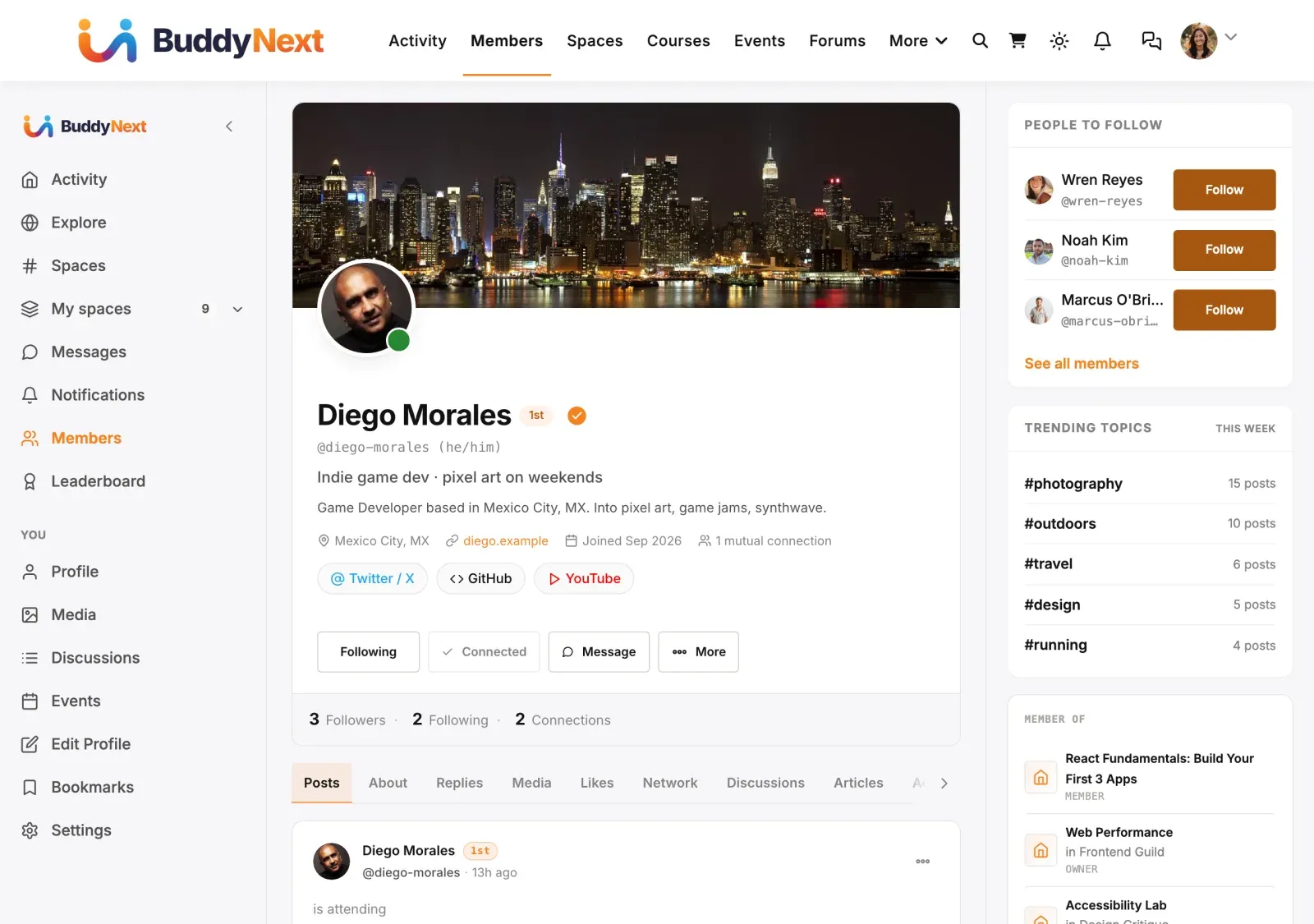
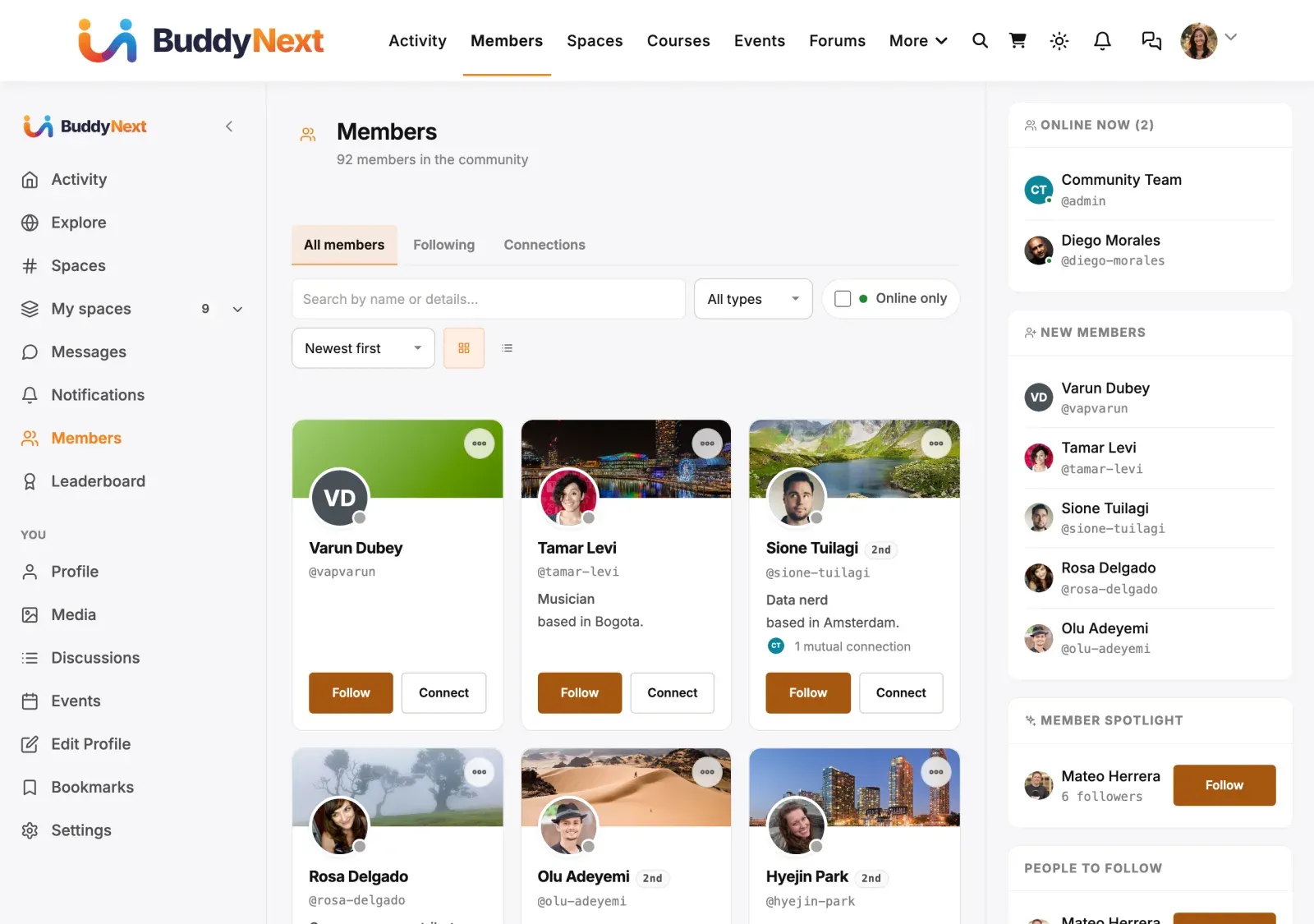
This page documents the largest REST surface in BuddyNext: the self-service /me/* routes, the per-user /users/{id}/* routes, profile-field and profile-group administration, member types, profile-slug checks, and the member directory. The /me/* and /users/{id}/* groups together account for roughly 63 routes under buddynext/v1. This page covers everything except the social-graph relationship routes (follow, connect, block, mute) that happen to live on the same /me/* and /users/{id}/* paths - those are documented on the REST: Social Graph page. Read the REST Contract page first; everything here assumes its namespace, nonce auth, envelope, and pagination rules.
Overview / Contract
Section titled “Overview / Contract”All routes register under buddynext/v1. Authentication, the success/error envelope, and cursor pagination follow the REST Contract page without exception:
| Rule | Value |
|---|---|
| Namespace | buddynext/v1 |
| Auth | X-WP-Nonce header (cookie session) or Application Password (external) |
| Self routes | /me/* - operate on the authenticated caller; require login |
| Target routes | /users/{id}/* - act on a specific user; public reads or admin writes |
| Error body | { "code": "...", "message": "...", "data": { "status": N } } |
per_page max |
50 on directory and collection reads |
Permission callbacks fall into a few classes used throughout this surface:
| Callback | Meaning |
|---|---|
__return_true |
Public read; visibility is still enforced per row by the service layer |
require_auth |
Caller must be logged in (own /me/* data) |
require_admin |
Site admin (manage_options) |
require_moderator |
Anyone holding a moderation ability: a site admin, a community moderator, or a member granted one (see REST: Moderation and Trust) |
require_edit_any_profile |
Resolves buddynext-profile/edit-any through the role map |
can_set_user_type |
Self-assignable types, or admin for any user |
Note: Public-read routes (
__return_true) do not return everything to everyone. The Profile, Directory, and Member-Type services apply per-viewer privacy gates (profile visibility, directory opt-out, blocked/restricted relationships) before a row is serialized.
/me/* - the self-service surface
Section titled “/me/* - the self-service surface”Every route below operates on get_current_user_id() and requires a logged-in caller. The user ID is never in the path.
Profile, avatar, and cover
Section titled “Profile, avatar, and cover”| Method | Path | Auth | Purpose |
|---|---|---|---|
| GET | /me/profile |
require_auth | Read the caller’s own profile (all groups, fields, completion score) |
| PUT | /me/profile |
require_auth | Update the caller’s profile fields, display name, privacy, and notification prefs |
| GET | /me/profile-slug |
require_auth | Read the caller’s current profile slug |
| PUT | /me/profile-slug |
require_auth | Change the caller’s profile slug (slug, sanitized via sanitize_title) |
| POST | /me/avatar |
require_auth | Upload the caller’s avatar |
| DELETE | /me/avatar |
require_auth | Remove the caller’s avatar (revert to default) |
| POST | /me/cover |
require_auth | Upload the caller’s cover image |
| DELETE | /me/cover |
require_auth | Remove the caller’s cover image |
Drafts, bookmarks, and shares
Section titled “Drafts, bookmarks, and shares”| Method | Path | Auth | Purpose |
|---|---|---|---|
| GET | /me/drafts |
require_auth | List the caller’s saved composer drafts |
| POST | /me/drafts |
require_auth | Save a new composer draft |
| DELETE | /me/drafts |
require_auth | Clear the caller’s composer draft |
| GET | /me/bookmarks |
require_auth | List the caller’s bookmarked posts (gated by the bookmarks feature flag, buddynext_feature_enabled( 'bookmarks' )) |
| GET | /me/shares |
require_auth | List posts the caller has shared |
Blocked, muted, and restricted lists
Section titled “Blocked, muted, and restricted lists”These are read-only list views of the caller’s own social-graph state. The write actions that populate them (POST /users/{id}/block, /mute, /restrict) are on the Social Graph page.
| Method | Path | Auth | Purpose |
|---|---|---|---|
| GET | /me/blocked |
require_auth | List users the caller has blocked. Accepts page, per_page (default 50) and expand=members (the default) |
| GET | /me/muted |
require_auth | List users the caller has muted |
| GET | /me/restricted |
require_auth | List users the caller has restricted |
Onboarding and presence
Section titled “Onboarding and presence”| Method | Path | Auth | Purpose |
|---|---|---|---|
| GET | /me/onboarding |
require_auth | Read the caller’s onboarding wizard state (current step, completion) |
| POST | /me/onboarding/step |
require_auth | Persist progress for one onboarding step |
| POST | /me/onboarding/skip |
require_auth | Skip the onboarding wizard |
| POST | /me/onboarding/complete |
require_auth | Mark onboarding complete (fires buddynext_onboarding_completed). Optional body carries the wizard’s answers: display_name, bio, slug, channels, spaces, user_ids, interests. |
| GET | /me/interests |
require_auth | Read the caller’s picked interest categories as { interests: [ { id, name }, ... ] } (deleted categories drop out) |
| POST | /me/interests |
require_auth | Persist the caller’s interest categories. Body: interests (array of category IDs). Returns { saved: true, interests: [...] } |
| POST | /me/presence/heartbeat |
require_auth | Refresh the caller’s bn_last_active stamp for online/presence |
/me/interestswrites through the profile store, not user meta. The picks land in the systeminterestsprofile field (acategory_multiselect, onebn_profile_valuesrow per pick) -POST /me/interestsis a thin alias over the canonical profile-save path, so a pick made here is the same valuePUT /me/profilewould write.
Social login providers
Section titled “Social login providers”| Method | Path | Auth | Purpose |
|---|---|---|---|
| GET | /me/social |
is_user_logged_in | The caller’s sign-in accounts as Settings lists them: one row per provider that is linked or ready to connect, each { id, label, icon, linked, only_credential, connect_url }. only_credential is true when unlinking would leave no way to sign in, in which case the unlink is refused. |
| DELETE | /me/social/{provider} |
is_user_logged_in | Unlink a connected social-login provider; {provider} matches [a-z0-9_-]+ |
Notification and space-notification preferences
Section titled “Notification and space-notification preferences”| Method | Path | Auth | Purpose |
|---|---|---|---|
| GET | /me/notifications |
require_auth | List the caller’s in-app notifications |
| GET | /me/notifications/unread-count |
require_auth | Unread notification count |
| PUT | /me/notifications/read-all |
require_auth | Mark every notification read |
| PUT | /me/notifications/{id}/read |
require_auth | Mark one notification read |
| DELETE | /me/notifications/{id} |
require_auth | Delete one notification |
| GET | /me/notification-prefs |
require_auth | Read per-type notification preferences |
| GET | /me/notification-channels |
require_auth | Read per-channel delivery preferences (in-app, email, push) |
| GET | /me/space-notification-prefs |
require_auth | Read per-space notification overrides |
Note: The three preference surfaces are read here; the matching writes (
PUT /me/notification-prefs,PUT /me/notification-channels,POST /me/space-notification-prefs) and the remaining notification routes (seen,unread,this-week) are documented on the REST: Notifications page. See the Notifications schema page for the underlyingbn_notification_prefsstorage.
Account: 2FA, password, email, and sessions
Section titled “Account: 2FA, password, email, and sessions”Two-factor lives under /account/2fa/*; password, email, and session controls live under /auth/*. Both groups require a logged-in caller.
| Method | Path | Auth | Purpose |
|---|---|---|---|
| GET | /account/2fa |
login | Read the caller’s 2FA status |
| POST | /account/2fa/setup |
login | Begin TOTP setup (returns secret/QR provisioning data) |
| POST | /account/2fa/confirm |
login | Confirm setup with a verification code |
| POST | /account/2fa/disable |
login | Disable 2FA on the account |
| POST | /account/2fa/backup |
login | Regenerate backup codes |
| POST | /auth/change-password |
require_auth | Change password (current_password, new_password) |
| POST | /auth/change-email |
require_auth | Change account email (email) |
| POST | /auth/sign-out-everywhere |
require_auth | Destroy all of the caller’s other sessions |
Note:
/auth/2faand/auth/2fa/email-code(under the auth namespace, permission__return_true, gated byusers_can_register) are part of the login challenge flow, not account management. They are documented on the REST: Auth page.
Appeals and self-service privacy
Section titled “Appeals and self-service privacy”| Method | Path | Auth | Purpose |
|---|---|---|---|
| POST | /me/appeals |
require_auth | Submit an appeal against a moderation action (fires buddynext_appeal_submitted) |
| GET | /me/data-export |
require_auth | Download the caller’s own data (gated by buddynext_allow_data_export, per-user cooldown) |
| DELETE | /me/account |
require_auth | Self-delete the caller’s account. Body: password (re-verified before anything is erased; 400 password_required / 422 incorrect_password). Refused with 403 when account deletion is turned off, and always for administrators. |
/users/{id}/* - routes that target a specific user
Section titled “/users/{id}/* - routes that target a specific user”{id} matches [\d]+. Reads here are public (privacy-gated per row); writes are administrative.
Profile view and admin media
Section titled “Profile view and admin media”| Method | Path | Auth | Purpose |
|---|---|---|---|
| GET | /users/{id}/profile |
public | View a user’s profile (privacy-gated for the current viewer) |
| PUT | /users/{id}/profile |
require_edit_any_profile | Admin edit of another user’s profile fields |
| POST | /users/{id}/avatar |
require_edit_any_profile | Admin upload of a user’s avatar |
| DELETE | /users/{id}/avatar |
require_edit_any_profile | Admin removal of a user’s avatar |
| POST | /users/{id}/cover |
require_edit_any_profile | Admin upload of a user’s cover image |
| DELETE | /users/{id}/cover |
require_edit_any_profile | Admin removal of a user’s cover image |
| GET | /users/{id}/spaces |
public | The spaces a member belongs to (the profile “Member of” card), as { id, name, slug, type, role, url } rows. Query: per_page (default 5, max 50). Secret spaces appear only when the viewer is in them too; 404 user_not_found when the viewer cannot see the profile. |
| GET | /users/{id}/feed |
public | A user’s own post timeline (gated by buddynext_public_explore) |
| GET | /users/{id}/likes |
public* | Posts the member reacted to (profile Likes tab), keyset cursor paging. See the feed reference. |
| GET | /users/{id}/replies |
public* | The member’s replies with the post each answers (profile Replies tab), keyset cursor paging. See the feed reference. |
Companion-gated member routes
Section titled “Companion-gated member routes”Registered by JetonomyBridge and present only when the Jetonomy companion is active. Note the /members/ prefix (not /users/) - this route mirrors the SSR profile Discussions tab so the native app renders the same panel.
| Method | Path | Auth | Purpose |
|---|---|---|---|
| GET | /members/{id}/discussions |
public | A member’s Discussions credential panel: { accepted_answers, reputation, trust_level, discussion_count, discussions: [ { id, title, url, reply_count, vote_score, space_name, created_at }, ... ] } (up to 20 recent). Returns 404 when the member does not exist. |
The space-scoped Jetonomy bridge routes (POST /spaces/{id}/forum, GET /spaces/{id}/discussion-search) are documented on the REST: Spaces page.
Member Blog bridge: articles
Section titled “Member Blog bridge: articles”Registered by MemberBlogBridge / MemberBlogRestController, present only when the Member Blog companion is active. Reads the member’s published WordPress posts through WP_Query (the same posts the profile Articles tab renders) - there are no Member Blog tables or functions involved beyond the one dashboard URL.
| Method | Path | Auth | Purpose |
|---|---|---|---|
| GET | /members/{id}/blog |
public, drafts/pending filtered in handler | A member’s published articles, paginated (page). Drafts and pending posts are visible only to the owner or an editor - the same rule the Articles tab applies. |
Moderation actions targeting a user
Section titled “Moderation actions targeting a user”These are administrative moderation routes. The member-facing counterpart is POST /me/appeals above.
Every route below except warn uses the require_moderator permission callback: a site admin, a community moderator, or a member granted the matching moderation ability. The one exception is POST /users/{id}/warn, which is authenticated at the route and authorized inside the handler, so a space owner or moderator may warn a member within a space they moderate. See REST: Moderation and Trust for the full authorization model.
| Method | Path | Auth | Purpose |
|---|---|---|---|
| GET | /users/{id}/strikes |
moderator | List a user’s strikes |
| POST | /users/{id}/strikes/{sid}/reverse |
moderator | Reverse a specific strike |
| POST | /users/{id}/suspend |
moderator | Suspend a user. Body: reason_code (or free-text reason), note, duration_days, hide_posts |
| GET | /users/{id}/suspension |
moderator | Read a user’s active suspension |
| GET | /users/{id}/suspensions |
moderator | List a user’s suspension history |
| POST | /users/{id}/warn |
auth + space scope | Issue a warning (fires buddynext_user_warned). Site admins may warn anyone; a space owner/moderator only within a space they moderate (pass space_id). |
| GET | /users/{id}/warnings |
moderator | List a user’s warnings |
| POST | /users/{id}/strikes |
moderator | Add a strike (reason) |
| DELETE | /users/{id}/suspend |
moderator | Lift a suspension |
| GET | /users/{id}/shadow-ban |
moderator | Read a user’s shadow-ban state |
| POST | /users/{id}/shadow-ban |
moderator | Shadow-ban a user |
| DELETE | /users/{id}/shadow-ban |
moderator | Lift a shadow-ban |
Note: The relationship and trust actions that also live on
/users/{id}/*-block,mute,restrict,connect(+ accept/decline),follow,followers,following,connection/status,mutual-connections,account-type- are member-driven social-graph routes, not moderation. They are documented in full on the REST: Social Graph page.
Profile fields and groups (CRUD + reorder)
Section titled “Profile fields and groups (CRUD + reorder)”Profile groups contain fields. Lists are public; all writes require require_admin. Reorder uses a direction enum (up/down) rather than absolute positions, so concurrent reorders stay consistent.
Groups
Section titled “Groups”| Method | Path | Auth | Purpose |
|---|---|---|---|
| GET | /profile-groups |
public | List all group definitions (metadata only) |
| POST | /profile-groups |
require_admin | Create a group (group_key, label, type, visibility, sort_order) |
| PUT | /profile-groups/{id} |
require_admin | Update a group (label, visibility, sort_order) |
| DELETE | /profile-groups/{id} |
require_admin | Delete a group |
| POST | /profile-groups/{id}/reorder |
require_admin | Move a group up or down (direction) |
Fields
Section titled “Fields”| Method | Path | Auth | Purpose |
|---|---|---|---|
| GET | /profile-fields |
public | List all field definitions |
| POST | /profile-fields |
require_admin | Create a field (group_id or group_name, field_key, label, type, options, description, placeholder, is_required, is_searchable, show_on_register, show_in_header, visibility, sort_order) |
| PUT | /profile-fields/{id} |
require_admin | Update a field (any of the create fields except field_key: label, type, options, description, placeholder, is_required, is_searchable, show_on_register, show_in_header, visibility, sort_order, group_id) |
| DELETE | /profile-fields/{id} |
require_admin | Delete a field |
| POST | /profile-fields/{id}/reorder |
require_admin | Move a field up or down (direction) |
Member types (CRUD + assignment)
Section titled “Member types (CRUD + assignment)”Type definitions are public to read and admin to write. Assignment to a user is admin for any user, or self-assignable types via can_set_user_type.
| Method | Path | Auth | Purpose |
|---|---|---|---|
| GET | /member-types |
public | List all member-type definitions |
| POST | /member-types |
require_admin | Create a member type |
| PUT | /member-types/{slug} |
require_admin | Update a member type; {slug} matches [a-z0-9-]+ |
| DELETE | /member-types/{slug} |
require_admin | Delete a member type |
| GET | /users/{id}/member-type |
public | Read a user’s assigned type |
| PUT | /users/{id}/member-type |
can_set_user_type | Assign a type to a user (type_slug; fires buddynext_member_type_assigned) |
| DELETE | /users/{id}/member-type |
require_admin | Remove a user’s type (fires buddynext_member_type_removed) |
Profile-slug check and member directory
Section titled “Profile-slug check and member directory”| Method | Path | Auth | Purpose |
|---|---|---|---|
| GET | /profile-slug/check |
require_auth | Check whether a slug is available (slug) |
| GET | /members |
public | Paginated member directory |
| GET | /search/members |
public | Member search (see REST: Search page) |
GET /members accepts these query parameters:
| Param | Type | Default | Notes |
|---|---|---|---|
search |
string | "" |
Free-text name/handle search |
sort |
string | newest |
One of newest, alphabetical, most_active, online |
relation |
string | all |
One of all, following, connections (viewer-relative) |
member_type |
string | "" |
Filter by member-type slug |
location |
string | "" |
Filter by location field |
online |
boolean | false |
Only members currently online |
cursor |
string | "" |
Opaque cursor from the previous page’s next_cursor |
per_page |
integer | 20 |
Clamped to a hard maximum of 50 |
messageable |
boolean | false |
Recipient-picker mode: only members the viewer may message (mvs_can_send_message); pages over the filter so a page is not returned short |
Note:
relation=followingandrelation=connectionsare applied inside the directory query (a JOIN onbn_follows/ connections), so the total count and cursor reflect the filtered set. Do not post-filter directory rows on the client.
Examples
Section titled “Examples”Update my profile
Section titled “Update my profile”PUT /me/profile accepts a flat JSON object of field_key => value. Core fields (display_name), profile fields (headline, bio, location, website, social_*), privacy gates, and notification toggles can all be sent in one call. Unknown keys are ignored. URL fields are accepted without a protocol (https is prefixed). A clean save returns 200; field-level validation failures return 422 with an errors map the client can render inline.
curl -X PUT 'https://example.com/wp-json/buddynext/v1/me/profile' \ -H 'X-WP-Nonce: <nonce>' \ -H 'Content-Type: application/json' \ --data '{ "display_name": "Ada Lovelace", "headline": "Mathematician and writer", "bio": "Working on the Analytical Engine.", "location": "London", "website": "ada-lovelace.example", "social_github": "https://github.com/ada", "bn_privacy_profile_visibility": "followers", "bn_pref_email_digest": true }'Success response (200):
{ "saved": true, "errors": [], "profile": { "user_id": 12, "completion": 80, "groups": [], "fields": { "headline": "Mathematician and writer", "bio": "Working on the Analytical Engine.", "location": "London", "website": "https://ada-lovelace.example" } }}Validation-failure response (422):
{ "saved": false, "errors": { "website": "Enter a valid URL (https://example.com).", "display_name": "Display name is required." }}Create a profile field
Section titled “Create a profile field”POST /profile-fields requires require_admin. field_key and label are required, plus a group via group_id or group_name; type, is_required, and sort_order default as shown. The create returns 201 with the new field ID.
curl -X POST 'https://example.com/wp-json/buddynext/v1/profile-fields' \ -H 'X-WP-Nonce: <nonce>' \ -H 'Content-Type: application/json' \ --data '{ "group_id": 1, "field_key": "favorite_language", "label": "Favorite programming language", "type": "text", "is_required": false, "sort_order": 5 }'Success response (201):
{ "id": 42 }Notes / gotchas
Section titled “Notes / gotchas”- Social-graph routes live on these same paths.
/me/blocked,/me/muted,/me/restricted,/me/connections,/me/connection-requests,/me/follow-requests*, and the/users/{id}/actions forblock,mute,restrict,connect,follow,followers,following,connection/status,mutual-connections, andaccount-typeare detailed on the REST: Social Graph page. They are grouped there because they share the social-graph services and hooks, even though their paths sit under/me/*and/users/{id}/*. - Public reads are privacy-gated, not open. A
__return_truepermission callback means the route is reachable without login; it does not mean every row is returned. Profile visibility, directory opt-out, and blocked/restricted relationships are enforced row-by-row in the service layer. - Reorder is relative. Field and group reorder take a
directionenum (up/down), not an absolute index, so two admins reordering at once cannot corrupt the order. - Profile writes are split by storage.
PUT /me/profileroutes core fields towp_update_user, privacy and notification keys to user meta (through PrivacyService for the gate keys, sobuddynext_privacy_preference_changedfires), and everything else to profile-value rows - all in one request. - Free vs Pro. Every route on this page is Free (
buddynext/v1). Pro adds advanced field renderers and membership-driven profile surfaces underbuddynext-pro/v1; it reads Free profile data through the Profile service rather than re-registering these routes.